
Can a Solicitor Help With a UK Spouse Visa Application?
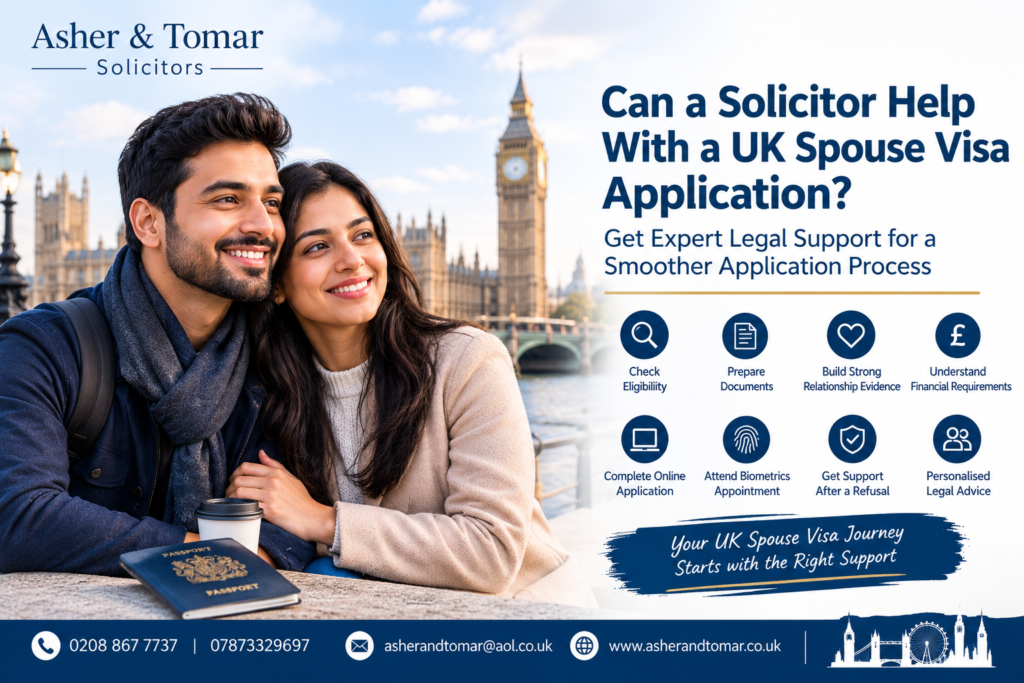
Checking eligibility before submitting the application can help you understand what evidence you need and whether any issues should be addressed first. However, legal advice cannot guarantee that the Home Office will approve an application. Can a Solicitor Help With a UK Spouse Visa Application by Preparing Documents? Supporting documents are an essential part of a spouse visa application. Applicants need to provide evidence relevant to their personal circumstances and the requirements of the route they are applying under. An immigration solicitor can help prepare a tailored document checklist, review the records you already have and identify missing or inconsistent information. Depending on your circumstances, documents may include: Not every applicant needs exactly the same documents. A solicitor can explain which evidence is relevant to your case and whether additional information may be required. Careful preparation can also help identify discrepancies in names, dates, addresses or employment details before the application is submitted. Can a Solicitor Help With a UK Spouse Visa Application When Financial Requirements Are Difficult? The financial requirement is an area where applicants may benefit from individual legal guidance. The applicable rules specify which income sources and savings can be relied upon and what evidence must be provided. For many new partner-route applications, the minimum income requirement is £29,000 per year. However, transitional arrangements and certain exceptions may apply, so applicants should confirm the requirements relevant to their circumstances. A solicitor can help you understand how the rules may apply if your partner is employed, self-employed, receives pension income or intends to rely on qualifying savings or other permitted income. For example, an applicant may have sufficient income but lack the correct supporting records. Another applicant may have irregular earnings or income from a business that requires more detailed documentation. Legal guidance can help clarify the relevant evidence requirements and identify potential gaps. The Home Office’s financial rules are specific, and simply providing a high bank balance or a general employment letter may not satisfy every application category. Before applying, check the latest official UK partner visa financial requirements. Can a Solicitor Help With a UK Spouse Visa Application by Reviewing Relationship Evidence? Applicants must demonstrate that their relationship meets the requirements of the relevant immigration route. A marriage certificate is important, but additional evidence may be needed to explain the relationship and show that it is genuine and continuing. A solicitor can help identify appropriate evidence based on your relationship history. This may include joint tenancy agreements, utility bills, shared financial records, evidence of visits and relevant communication records. Couples do not always have identical circumstances. Some have lived together for several years, while others have recently married and are living in separate countries because of work, study or immigration restrictions. In these situations, a solicitor can explain how to present the available evidence clearly and whether additional explanations may be helpful. For applicants in arranged marriages or couples with limited joint financial records, advice can help ensure that the application reflects their real circumstances rather than relying on assumptions about what every relationship should look like. The aim is to submit relevant, genuine evidence that supports the information in the application. Documents should never be altered or created to give a misleading impression. Can a Solicitor Help With a UK Spouse Visa Application From India? Yes. Eligible applicants living in India can generally apply for a UK Spouse Visa from outside the United Kingdom. The process involves completing the appropriate online form, providing supporting evidence and following the instructions for biometrics. Applicants applying from India may need to consider overseas marriage records, certified translations, financial evidence relating to a UK-based sponsor and documents explaining periods spent living apart. A solicitor can help review the application and explain the evidence requirements before submission. This may be particularly helpful if the couple has different addresses, has recently married or needs to clarify previous immigration circumstances. The applicant must still follow the official application instructions, including any requirements relating to biometric appointments and document submission. Legal assistance can help with preparation, but it does not replace the applicant’s responsibility to provide accurate information and comply with the applicable immigration rules. Can a Solicitor Help With a UK Spouse Visa Application Form? The online application asks for detailed information about the applicant, sponsoring partner, relationship history, finances and immigration background. Incorrect or inconsistent answers can create avoidable complications. A solicitor can help you understand the questions, review the information being provided and check whether the answers are consistent with your supporting documents. For example, differences between an address stated on the form and an address appearing on a bank statement may need clarification. Details of previous marriages or immigration applications must also be handled accurately. Depending on the agreed scope of work, a solicitor may advise on the application, assist with its preparation and review supporting evidence before submission. Applicants should provide complete and truthful information throughout the process. If a question is unclear or an unusual circumstance needs explaining, obtaining advice before submitting the form may help you make an informed decision. Can a Solicitor Help With a UK Spouse Visa Application After a Refusal? If your spouse visa application has been refused, a solicitor can review the decision letter and explain the potential options available in your circumstances. The appropriate response depends on the refusal reasons and the legal route involved. Depending on the case, possible options may include an appeal where a right of appeal exists, an administrative review where available, or submitting a fresh application. A solicitor can help identify whether the refusal relates to financial evidence, relationship documentation, eligibility, inconsistencies or another immigration issue. Before making another application, it is important to understand what went wrong and whether the underlying problem can be addressed. Simply resubmitting the same evidence may not resolve the issue. Deadlines for challenging a decision can be strict. If you receive a refusal, seek appropriate advice promptly and follow the instructions in your decision letter. Can a Solicitor Help
UK Spouse Visa Relationship Requirements: A Complete Guide

UK Spouse Visa Relationship Requirements – Applying for a UK Spouse Visa involves demonstrating that your relationship meets the relevant UK immigration requirements. A marriage certificate is an important document, but applicants may also need to provide evidence that their relationship is genuine, continuing and based on a real commitment to living together in the United Kingdom. For couples applying from India or another country, preparing relationship evidence can sometimes feel challenging, particularly when partners have lived in different countries, recently married or maintained separate financial arrangements. Understanding what the Home Office may consider can help you organise your documents and present your circumstances clearly. Asher & Tomar Solicitors can provide guidance on UK spouse visa applications, supporting documents and relationship evidence tailored to individual circumstances. UK Spouse Visa Relationship Requirements: What Must Couples Prove? UK Spouse Visa Relationship Requirements – Applicants must meet the relationship criteria applicable to their chosen immigration route. For a spouse visa, this generally includes being in a marriage or civil partnership recognised under UK law, having met in person, and demonstrating that the relationship is genuine and continuing. The applicant and sponsoring partner must normally be at least 18 years old and intend to live together permanently in the UK. Any previous marriage or civil partnership must have ended permanently where relevant. The sponsoring partner must also meet the applicable immigration status requirements. Depending on the circumstances, this may include being a British or Irish citizen, holding settled status or qualifying under another permitted category. Relationship eligibility is only one part of the application. Applicants must also consider financial requirements, English language rules, accommodation and other applicable immigration conditions. UK Spouse Visa Relationship Requirements: Is a Marriage Certificate Enough? A valid marriage certificate is important evidence that a couple is legally married. However, it does not automatically establish that every requirement for a UK Spouse Visa has been met. The Home Office may assess the wider circumstances of the relationship, including how the couple met, their relationship history, communication, shared responsibilities and plans for their future together. Applicants should provide a marriage certificate alongside other relevant documents that help explain their circumstances. Depending on the case, this may include evidence of visits, shared accommodation, financial commitments, family life and regular communication. If the marriage took place overseas, ensure that the certificate is valid and that any required translation is provided. Documents that are not in English or Welsh generally need a certified translation meeting the relevant requirements. The objective is to provide a clear and consistent account of the relationship rather than submitting a large collection of unrelated documents. UK Spouse Visa Relationship Requirements: Documents to Prove a Genuine Relationship Relationship evidence should reflect the couple’s actual circumstances. There is no single document that every applicant must provide in every case. The suitability of the evidence depends on the relationship history and the documents available. Examples of potentially useful evidence include: Official documents from banks, landlords, utility providers or government bodies can be useful when they establish a shared address or financial commitment. Applicants should select evidence that is relevant to their own relationship. For example, couples who have recently married may have fewer joint household documents than partners who have lived together for several years. Their evidence should reflect that difference rather than attempt to imitate another couple’s circumstances. UK Spouse Visa Relationship Requirements: What If You Live Apart? Living apart does not automatically prevent a couple from qualifying for a UK Spouse Visa. Partners may live in different countries because of employment, education, immigration restrictions, family responsibilities or cultural circumstances. In these situations, applicants should demonstrate that their relationship remains genuine and continuing despite the physical distance. Useful evidence may include regular calls and messages, records of visits, travel documents, photographs from time spent together, evidence of financial support and information about plans to establish a shared home in the UK. Where possible, explain why the couple has been living apart and how they have maintained their relationship. For example, one partner may have employment commitments in the UK while the other continues working overseas until the visa application is decided. The evidence should tell a coherent story. Applicants do not need to submit every message or call record. A carefully selected sample covering relevant periods may be more useful than an excessive volume of repetitive material. UK Spouse Visa Relationship Requirements: How to Show Shared Financial Responsibilities Shared financial responsibilities can help demonstrate the practical aspects of a relationship, although a joint bank account is not compulsory in every case. Couples may provide evidence of shared rent, household bills, joint savings, mortgage payments, childcare costs or other genuine financial commitments. Where one partner supports the other financially, relevant transfer records or supporting documents may help explain the arrangement. Some married couples maintain separate bank accounts for personal, professional or cultural reasons. This does not automatically mean that their relationship is not genuine. The important consideration is the overall evidence and whether it accurately reflects their circumstances. Applicants should avoid opening accounts or creating financial arrangements solely to manufacture evidence. Documents should demonstrate the real nature of the relationship and any genuine shared responsibilities. The spouse visa financial eligibility requirement is a separate consideration. Evidence of shared finances may support the relationship assessment, but it does not necessarily establish that the immigration financial threshold has been met. UK Spouse Visa Relationship Requirements: Arranged Marriages and Cultural Considerations Arranged marriages are common in many communities, including Indian families. A couple may have met through relatives, spoken for a relatively short period before marriage or begun living together only after the wedding. These circumstances do not automatically make a relationship unsuitable for a UK Spouse Visa. The relevant question is whether the relationship meets the applicable immigration rules and is genuine and continuing. Depending on the circumstances, supporting evidence might include marriage records, photographs from the wedding, communication before and after marriage, records of visits and information about family involvement. Where the couple
UK Spouse Visa Application Process: A Complete Guide
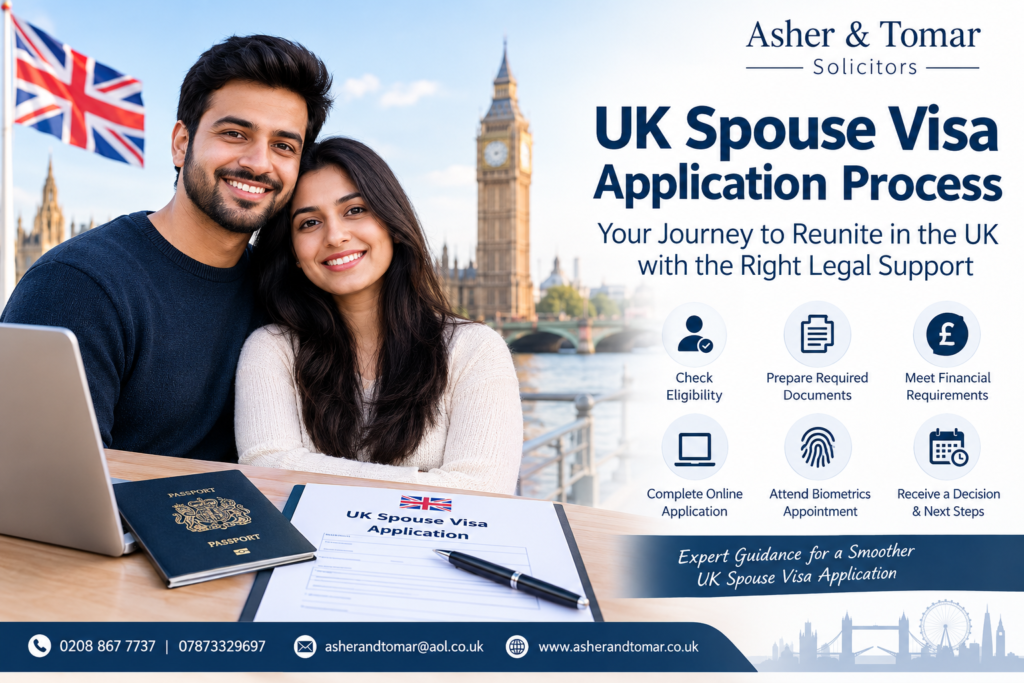
The UK Spouse Visa Application Process allows eligible individuals to join their husband or wife in the United Kingdom and build their family life together. However, submitting an application involves more than providing a marriage certificate. Applicants must satisfy the relevant immigration requirements, demonstrate that their relationship is genuine, provide appropriate financial evidence and complete the application correctly. Whether you are applying from India or another country, understanding each stage can help you prepare a clearer and more complete application. At Asher & Tomar Solicitors, applicants can seek legal guidance on the requirements, supporting documents and potential issues affecting their individual circumstances. UK Spouse Visa Application Process: Who Can Apply? A UK Spouse Visa is generally available to people whose partner is a British or Irish citizen, is settled in the UK, or meets another qualifying immigration category specified in the rules. Both partners must normally be aged 18 or over and intend to live together permanently in the UK. Applicants must establish that their marriage or civil partnership is legally recognised in the UK. In certain circumstances, unmarried partners may qualify under the relevant relationship rules, while people planning to marry in the UK may need to consider the separate fiancé or proposed civil partner route. Eligibility depends on the applicant’s circumstances and the immigration status of their sponsoring partner. Previous marriages must have permanently ended where applicable, and the couple must provide credible evidence of their ongoing relationship. Before beginning an application, review the official UK partner and spouse visa guidance to establish which route applies to your situation. UK Spouse Visa Application Process: Check the Financial Requirements Meeting the financial requirement is an important part of many spouse visa applications. Under the rules generally applicable to new partner-route applications, the minimum income requirement is £29,000 per year. However, different provisions may apply to certain existing applicants, people extending a visa under transitional arrangements and sponsors receiving specified disability or carer-related benefits. Depending on the circumstances, qualifying income, eligible cash savings, pension income and other permitted financial sources may be relevant. The rules governing which sources can be combined and how they must be evidenced are specific, so applicants should not assume that every type of income will automatically count. Financial evidence may include: The required evidence depends on the financial category being used. Documents should be consistent, complete and compliant with the applicable rules. Applicants should check the latest UK Spouse Visa financial requirements before submitting their application, particularly if their income is irregular, they are self-employed or they intend to rely on savings. UK Spouse Visa Application Process: Prepare the Required Documents Organising the correct paperwork before completing the online form can make the process easier to manage. The exact document checklist varies according to the applicant’s nationality, relationship history, financial circumstances and previous immigration applications. Commonly required documents and evidence include: Applicants may also need to provide information about their family members, previous immigration applications, travel history and other personal circumstances. If you are applying from India, check that your marriage certificate and other records are suitable for the application. Documents in Hindi or another language may require certified English translations. Follow the current application instructions rather than assuming that the same checklist applies to every applicant. UK Spouse Visa Application Process: Prove Your Relationship Is Genuine A marriage certificate is important, but additional evidence may be needed to demonstrate that the relationship is genuine and continuing. The Home Office may consider the history of the relationship, shared responsibilities, communication and the couple’s plans to live together. Useful evidence can include joint tenancy agreements, council tax records, utility bills, joint bank statements and other reliable documents showing shared residence or financial commitments. Where the couple has lived apart because of work, study or cultural circumstances, evidence of regular communication, visits, financial support and continued commitment may help explain their situation. Evidence should be relevant, credible and consistent with the information supplied in the application. A large collection of unrelated photographs or messages is not necessarily as persuasive as a smaller, well-organised set of documents that clearly supports the relationship history. If you and your spouse have lived in different countries, explain the reasons for living apart and provide evidence that reflects your actual circumstances. Do not create documents or exaggerate details to strengthen an application. UK Spouse Visa Application Process: Meet the English Language Requirement Applicants normally need to demonstrate the required knowledge of English unless they qualify for an exemption. The accepted method depends on the applicant’s circumstances and the rules in force at the time of application. Depending on eligibility, evidence may involve an approved English language test, an accepted academic qualification taught in English or a qualifying nationality-based exemption. The level of English required can differ between an initial application, an extension and a settlement application. Before booking a test, confirm that the provider and test are approved for UK immigration purposes and that the result meets the relevant requirements. Using an unsuitable test or submitting evidence that does not meet the rules may delay the process. Applicants with medical conditions or other circumstances that may qualify for an exemption should establish the applicable requirements and gather appropriate supporting evidence before applying. UK Spouse Visa Application Process: Complete the Online Application Once you have identified the correct route and prepared the necessary information, the next stage is to complete the relevant online application through the official UK government website. The application will ask for personal details, passport information, relationship history, the sponsoring partner’s status, financial circumstances and other information relevant to eligibility. Answer each question accurately and ensure that the information matches the supporting documents. You will generally need to pay the applicable application fee and, where required, the Immigration Health Surcharge. The amount depends on the application type and current government rates, so verify the costs before proceeding. Applicants applying from outside the UK must normally apply online from abroad. Those already in the UK may be eligible to apply
Can My Spouse Work in the UK on a Dependent Visa?
Can My Spouse Work in the UK on a Dependent Visa? If you are moving to the United Kingdom for work or study, you may want your husband or wife to join you and continue their career. One of the most common questions couples ask is, “Can my spouse work in the UK on a dependent visa?” The answer depends on the immigration route under which your spouse receives permission to stay in the UK. Many eligible dependants of Skilled Worker visa holders can work, including in full-time employment or self-employment, subject to the conditions of their permission. Eligible dependants of some Student visa holders may also work, but their eligibility and employment conditions depend on the student’s course and immigration status. A dependant visa does not give every spouse identical rights. Certain visa routes have restrictions on bringing family members, and specific employment limitations may apply. It is therefore important to check the main visa holder’s immigration category and the conditions attached to the dependant’s permission before accepting a job. This guide explains UK dependant work rights, eligibility considerations, common restrictions and what couples should check before making employment plans. Can My Spouse Work in the UK on a Skilled Worker Dependent Visa? In many cases, yes. An eligible spouse or partner of a person holding a UK Skilled Worker visa can generally work in the UK if their dependant application is approved and their permission allows employment. The dependant’s permission will normally expire on the same date as the main visa holder’s permission. The dependant must follow the conditions attached to their own immigration status. Eligible Skilled Worker dependants can generally: There is an important exception: dependants generally cannot work as professional sportspersons, including as sports coaches, under this route. The main applicant’s occupation can also affect whether a spouse qualifies to join them as a dependant. Restrictions apply to certain care worker and senior care worker roles and some medium-skilled occupations under the Skilled Worker route. Transitional provisions and exceptions may apply to particular cases. Before making plans, check the latest GOV.UK Skilled Worker dependant guidance. Can My Spouse Work in the UK on a Student Dependent Visa? A spouse may be allowed to work in the UK as the dependant of an eligible international student. However, not every Student visa holder can bring a dependant, so the student’s course and circumstances must be checked first. Under the current Student route rules, dependants are generally permitted only in specified circumstances, including where the student is government-sponsored for an eligible course or is undertaking a qualifying full-time postgraduate research course. Different rules can apply depending on when the course began and the student’s immigration circumstances. Where a spouse qualifies for Student dependant permission, employment is generally permitted subject to the restrictions attached to that permission. Dependants are normally prohibited from working as professional sportspersons or sports coaches. The spouse should check their own visa conditions rather than relying only on the main applicant’s Student visa. Official guidance is available on the UK Student visa rules for partners and children. What Jobs Can a UK Dependent Visa Holder Do? For eligible dependants whose immigration conditions permit work, employment opportunities can include a wide range of professional and non-professional roles. Depending on their skills, qualifications and experience, they may look for work in areas such as: Office and professional employment: Administration, customer support, marketing, finance, human resources and business operations. Technology and digital services: Software development, IT support, data-related roles, digital marketing and website management. Retail and hospitality: Retail assistance, hotel operations, restaurant work and customer service. Education and specialist roles: Certain teaching, research and other skilled positions, subject to any professional registration or qualification requirements. Self-employment: Some dependant visa holders can freelance, provide services independently or run a business, subject to their immigration conditions and any other legal requirements. The right to work does not automatically mean a person meets the qualifications or professional registration requirements for a particular job. Employers may still ask for relevant experience, references, qualifications or professional accreditation. Can a UK Dependent Visa Holder Work Full-Time? Eligible dependants of Skilled Workers can generally work full-time, provided their permission allows employment and they comply with its conditions. The same broad principle applies to many eligible Student dependants, although the exact rules should be checked for their particular circumstances. A dependant’s work rights are not necessarily the same as those of the main visa holder. If your spouse is planning to accept a full-time position, start a business or change careers after arriving in the UK, check the wording of their immigration permission first. Employers will also need to complete the appropriate right-to-work checks before employment begins. Having a dependant visa should not be treated as a substitute for verifying the person’s actual immigration status and work conditions. Can My Spouse Work Without Employer Sponsorship? In many cases, an eligible dependant of a Skilled Worker does not need separate Skilled Worker sponsorship to take an ordinary job. Their permission to work comes from their dependant immigration status rather than from an individual sponsored job. This can provide flexibility when looking for employment or changing employers. However, there is an important distinction between working as a dependant and applying for a visa in one’s own right. If your spouse wants to switch to their own Skilled Worker visa, they will generally need to meet that route’s requirements, including having an eligible sponsored job and meeting the applicable salary and other criteria. A dependant who has permission to work should still check whether a particular job is compatible with their immigration conditions. Can My Spouse Be Self-Employed on a UK Dependent Visa? Many eligible dependants can undertake self-employment, freelance work or business activities. This may be useful for people who want to continue providing professional services, build a client base or establish a business in the UK. For example, an eligible dependant may be able to work independently in digital marketing, consultancy, design, technology or other service-based sectors.
What to Do After UK Visa Refusal: Reapply, Appeal or Request a Review?
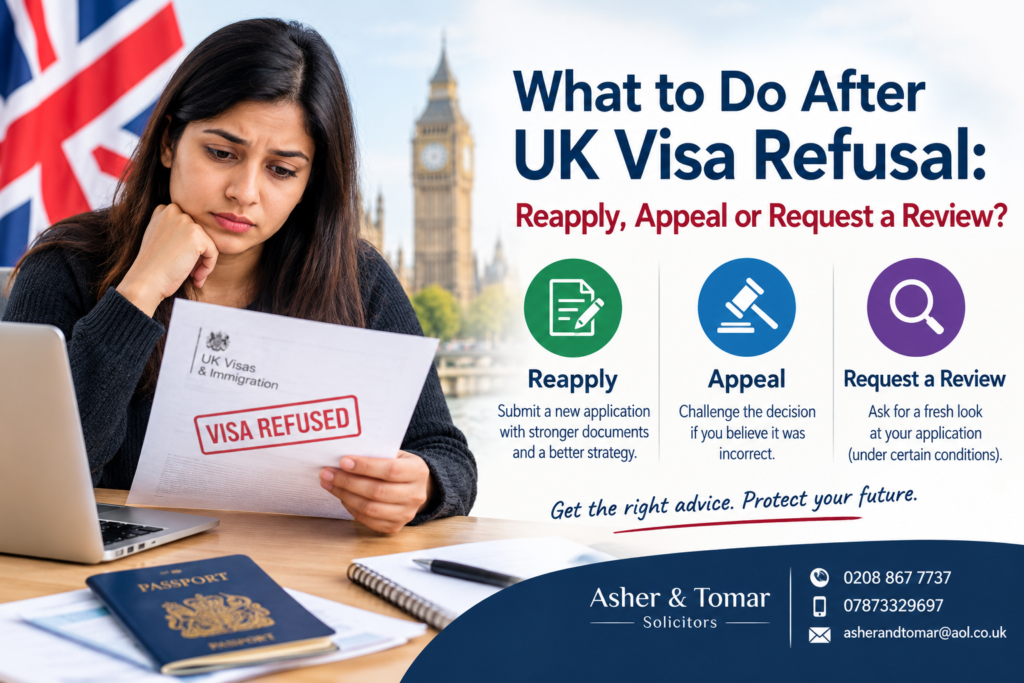
Receiving a UK visa refusal can be disappointing and confusing, particularly when you have already invested time, money and effort into your application. However, a refusal does not necessarily mean that you have no further options. Depending on the type of application, the reasons for refusal and the rights stated in your decision letter, you may be able to submit a fresh application, request an administrative review or appeal the decision. Understanding the difference between these options is important before taking the next step. Reviewing the refusal carefully and obtaining appropriate legal advice can help you decide which route may be suitable for your circumstances. Understand Why Your UK Visa Was Refused (What to Do After UK Visa Refusal: Reapply, Appeal or Request a Review?) The first step after receiving a UK visa refusal is to carefully read the decision letter. The letter should explain why the Home Office refused the application and, where applicable, whether you have a right to appeal or request an administrative review. GOV.UK advises applicants to check their decision letter to determine which options are available. Common reasons for refusal can include insufficient supporting evidence, concerns about financial circumstances, failure to meet a particular Immigration Rules requirement, credibility concerns, missing information or errors within the application. Understanding the precise reason for refusal is essential. Simply submitting the same application again without addressing the issues identified by the Home Office may not solve the underlying problem. Should You Reapply After a UK Visa Refusal? In some circumstances, making a fresh application may be appropriate. A new application can allow you to address weaknesses identified in the previous application and provide additional or clearer evidence where appropriate. For example, if the refusal relates to financial evidence, you may need to provide stronger documentation that clearly demonstrates your financial circumstances. If the refusal identifies concerns about the purpose of your visit, your new application may need to provide clearer evidence explaining your circumstances and intentions. A fresh application should not simply repeat the previous application. It should be carefully prepared with the refusal reasons in mind and should meet the requirements applicable to the new application. Can You Reapply Immediately After a UK Visa Refusal? There is no universal rule requiring every applicant to wait for a particular period before submitting a new UK visa application. However, whether reapplying immediately is sensible depends on the circumstances. If nothing has changed and the reasons for refusal have not been addressed, submitting another application may result in another refusal. On the other hand, if you can correct an error, provide missing evidence or demonstrate that you now meet the relevant requirements, a new application may be worth considering. Before submitting another application, it is important to assess the refusal carefully and determine whether a fresh application is the most appropriate route. When Could an Administrative Review Be Appropriate? An administrative review is different from making a new visa application. It is a process for challenging an eligible decision where you believe the Home Office made an error in considering your application. Not every refused UK visa application qualifies for administrative review. Your decision letter should explain whether you have this option. For eligible applications made outside the UK, GOV.UK currently states that an administrative review must generally be requested within 28 days of receiving the decision. For eligible applications made in the UK, the usual deadline is 14 days, subject to specific circumstances and rules. Because missing a deadline can have serious consequences, applicants should check their decision letter and obtain appropriate advice promptly. What Happens During an Administrative Review? An administrative review examines whether an eligible immigration decision was made incorrectly. It is not simply an opportunity to submit a completely new application with different circumstances. The grounds and evidence that can be considered depend on the relevant rules and the type of decision. Applicants should therefore avoid assuming that an administrative review works in exactly the same way as a fresh application. Another important point is that making a new immigration application can affect an existing administrative review. GOV.UK states that an administrative review request can be withdrawn if another immigration or visa application is made. This makes it particularly important to understand the consequences before choosing between a review and a fresh application. When Can You Appeal a UK Visa or Immigration Decision? An appeal is only available where there is a legal right of appeal. Not every UK visa refusal carries an appeal right. GOV.UK explains that the decision letter will usually tell you whether you have the right to appeal. Certain immigration decisions, including some human rights and protection claims, can carry appeal rights, while other cases may instead provide an administrative review or another route. If you do have a right of appeal, the deadline is important. GOV.UK currently states that, generally, an appeal must be submitted within 14 days if you are in the UK and within 28 days if you are outside the UK. The specific circumstances of the case should always be checked against the decision and applicable rules. Appeal or Reapply: Which Option Is Better? There is no single answer that applies to every UK visa refusal. The correct approach depends on why the application was refused and what legal options are stated in the decision. A fresh application may be appropriate where the applicant can correct deficiencies and submit a stronger application. An administrative review may be relevant where the applicant believes an eligible decision contains a caseworking error. An appeal may be appropriate where the applicant has a legal right of appeal and believes the decision should be challenged before the tribunal. Choosing the wrong route can waste time and money. It may therefore be sensible to obtain professional immigration advice before submitting anything further. What Evidence May Help With a New UK Visa Application? The evidence required will depend on the visa category and the reasons for the previous refusal. Depending on the circumstances, this may
Visa Sponsorship Solicitor UK: Legal Guidance for Employers & Sponsored Workers

Visa Sponsorship Solicitor UK Hiring overseas workers or applying for a sponsored work visa in the UK can involve detailed immigration requirements. Employers may need a sponsor licence before they can sponsor eligible workers, while applicants must satisfy the requirements of the relevant immigration route. A visa sponsorship solicitor in the UK can help employers understand their sponsorship responsibilities and assist individuals with sponsored work visa matters. The UK sponsorship system covers areas including sponsor licences, Certificates of Sponsorship, Skilled Worker applications, compliance obligations and immigration requirements. Current Home Office sponsor guidance was updated in 2026, so relying on outdated information can create unnecessary problems. Asher & Tomar Solicitors provides legal services for individuals and businesses dealing with UK immigration matters. What Is Visa Sponsorship in the UK? UK visa sponsorship allows an eligible employer to sponsor qualifying overseas workers under applicable immigration routes. Employers will usually need a sponsor licence to employ someone from outside the UK, although there are exceptions for certain categories of people, such as Irish citizens and some individuals with existing UK immigration status. Sponsorship itself does not guarantee that a worker will receive a visa. The sponsored worker must also meet the requirements of the relevant immigration route. This makes it important for both employers and prospective employees to understand their respective responsibilities before proceeding. Why Choose a Visa Sponsorship Solicitor UK? Immigration sponsorship involves more than completing an online application. Employers need to demonstrate that their organisation is suitable to sponsor workers and must continue to meet sponsorship duties after receiving a licence. A solicitor can help you understand issues such as: The Home Office’s current sponsor guidance explains that employers should understand the relevant licence requirements, application process, supporting evidence and ongoing sponsorship duties. What Is a UK Sponsor Licence? A sponsor licence allows an eligible organisation to sponsor workers under the relevant immigration routes. Before applying, an employer generally needs to establish that: The Home Office may assess the organisation and can visit the business as part of its assessment. A solicitor can review your circumstances before an application is submitted and help identify potential issues with your documentation or sponsorship arrangements. How Does a Sponsor Licence Application Work? The sponsor licence process starts with determining whether the organisation is eligible and which sponsorship route it needs. The employer then needs to: The Home Office’s current guidance contains detailed requirements concerning eligibility, key personnel, supporting evidence and how applications are assessed. Careful preparation can help reduce the risk of avoidable problems. What Is a Certificate of Sponsorship? A Certificate of Sponsorship (CoS) is an electronic record assigned by a licensed sponsor to an overseas worker. It contains information about the sponsored employment and is used by the worker as part of their immigration application. A Certificate of Sponsorship is not a physical certificate and does not itself grant immigration permission. The employer must ensure that the information provided is accurate and that the sponsored role meets the requirements of the relevant immigration route. Current Home Office guidance provides specific rules on assigning Certificates of Sponsorship. What Is Skilled Worker Sponsorship? The Skilled Worker route allows approved employers to sponsor eligible workers for qualifying jobs in the UK. An employer wishing to sponsor a Skilled Worker must hold a valid sponsor licence for the Skilled Worker route. The role and worker must also satisfy the applicable immigration requirements, including relevant skill and salary rules. Because the requirements can change, employers should check the rules applicable when sponsorship is being arranged. What Are the Responsibilities of a Sponsor? Receiving a sponsor licence is not the end of an employer’s obligations. Licensed sponsors have ongoing duties, which can include maintaining appropriate records, monitoring sponsored workers and reporting relevant changes to UKVI. The Home Office can take compliance action where sponsorship duties are breached or where it suspects non-compliance. Depending on the circumstances, non-compliance can have serious consequences for a sponsor licence. Professional legal advice can help businesses understand their responsibilities and establish appropriate sponsorship processes. Can a Small Business Sponsor an Overseas Worker? A small business may be able to apply for a sponsor licence if it satisfies the relevant requirements. There is no general rule that sponsorship is restricted only to large companies. However, the Home Office assesses whether an organisation is eligible and suitable to hold a licence. Businesses should be prepared to demonstrate that they are genuinely operating and can meet the relevant sponsorship responsibilities. What Documents Are Required for a Sponsor Licence? The documents required depend on the organisation and the type of licence being requested. Supporting evidence may relate to matters such as: The Home Office publishes a specific list of supporting documents for sponsor licence applications, and the requirements can be updated. A solicitor can help you review the documentation before submission. What Happens If a Sponsor Licence Is Refused? A sponsor licence application may be refused if the organisation does not satisfy the relevant requirements or the Home Office identifies concerns. The current sponsor guidance sets out circumstances in which applications may be refused, including specific concerns relating to an organisation’s suitability and sponsorship arrangements. If your sponsor licence has been refused, professional advice can help you understand the reasons given and assess what options may be available. Can a Sponsor Licence Be Lost? Yes. A sponsor licence is conditional on the organisation continuing to meet its sponsorship responsibilities. The Home Office can take action where a sponsor breaches its duties. Depending on the circumstances, this may affect the organisation’s ability to sponsor workers. This is why compliance should be treated as an ongoing business responsibility rather than a one-time application. Visa Sponsorship Advice for Overseas Workers Employees and prospective employees can also benefit from specialist immigration advice. If a UK employer has offered you a sponsored position, you may need to consider: A job offer alone does not automatically result in a successful visa application. Why Should You Get Legal Advice Before Applying? A sponsorship
UK Visa Sponsorship Solicitor London: Complete Guide for Employers and Workers

UK Visa Sponsorship Solicitor London Hiring overseas workers or applying for a sponsored UK work visa can involve detailed immigration requirements. For employers, the process may involve obtaining and maintaining a sponsor licence, understanding sponsorship duties and assigning the correct Certificate of Sponsorship. For workers, the application can involve meeting requirements relating to the sponsored role, salary, eligibility and supporting documentation. If you are searching for a UK visa sponsorship solicitor in London, professional legal guidance can help you understand the relevant immigration rules and approach your application with greater confidence. Asher & Tomar Solicitors provides immigration legal services for individuals and businesses dealing with UK immigration matters. The firm’s existing immigration services and resources include guidance relating to UK visa applications and sponsorship. What Is UK Visa Sponsorship? UK visa sponsorship is a system that allows eligible UK employers to sponsor qualifying overseas workers under relevant immigration routes. For many employers wishing to recruit workers from outside the UK, a sponsor licence is required. GOV.UK explains that employers will usually need a sponsor licence to employ someone from outside the UK, subject to specific exceptions. Sponsorship does not automatically guarantee that the worker will receive a visa. The sponsored employee must still satisfy the requirements of the relevant immigration route. This is why both employers and prospective employees should understand their individual responsibilities before proceeding. Why Do You Need a UK Visa Sponsorship Solicitor? UK immigration rules can be detailed and subject to change. A mistake in a sponsor licence application, supporting evidence or sponsored worker application may create unnecessary delays or complications. A UK visa sponsorship solicitor in London can help you understand: Legal advice should be tailored to the specific circumstances of the employer or applicant rather than based on a generic online checklist. How Does a UK Sponsor Licence Work? A UK employer generally needs a sponsor licence if it wants to sponsor eligible overseas workers under routes covered by the sponsorship system. The government application process involves checking whether the organisation is eligible, determining the appropriate licence type, identifying the people who will manage sponsorship and submitting an online application with the relevant fee and supporting information. UKVI may also visit a business to assess its suitability. A successful sponsor licence gives an organisation the ability to sponsor workers under the routes covered by its licence, provided the organisation continues to meet its sponsorship responsibilities. What Is a Skilled Worker Sponsor Licence? Employers wishing to sponsor workers under the Skilled Worker route need a valid sponsor licence for that route. The Skilled Worker route allows eligible employers to recruit people for specific jobs that meet the relevant requirements. Current Home Office guidance covers matters including eligible occupations, skill requirements, salary requirements and Certificates of Sponsorship. Employers should therefore check the current requirements before offering sponsorship. What Is a Certificate of Sponsorship? A Certificate of Sponsorship (CoS) is an electronic record assigned by a licensed sponsor to a worker who is being sponsored. It contains information about the employment and provides the reference information required for the worker’s visa application. A Certificate of Sponsorship is not the same as a visa. Receiving sponsorship does not itself mean that the applicant’s visa application will automatically be approved. Employers should ensure that the information assigned through the sponsorship system is accurate and consistent with the sponsored role. What Responsibilities Does a UK Sponsor Have? Obtaining a sponsor licence is only one part of the process. Licensed sponsors have ongoing responsibilities. These can include maintaining appropriate records, reporting relevant changes and complying with sponsorship requirements. The Home Office provides specific guidance on sponsor duties and compliance. The Sponsor Management System can be used by licensed employers to manage sponsorship, assign Certificates of Sponsorship and report relevant changes. Failure to comply with sponsorship duties can put a company’s licence at risk. What Documents Are Needed for Sponsorship? The documents required depend on the type of application and the organisation’s circumstances. For sponsor licence applications, businesses may need to provide specified supporting evidence. GOV.UK maintains current guidance on documents required for sponsor applications. Depending on the circumstances, information may relate to: A solicitor can help identify potential documentation issues before an application is submitted. Can Small Businesses Sponsor Overseas Workers? A business does not necessarily have to be a large corporation to consider sponsorship. Eligibility depends on the relevant immigration requirements and the organisation’s circumstances. Small and growing businesses should understand their sponsorship duties before applying. The Home Office assesses whether an organisation is suitable to hold a sponsor licence and whether it can meet its obligations. Professional advice can help a business assess its position before making an application. UK Visa Sponsorship Advice for Overseas Workers Employers are not the only people who may require immigration advice. If you have received an offer of sponsored employment in the UK, you may need to establish whether: Current Skilled Worker guidance sets out requirements covering areas such as eligible occupations, salary and Certificates of Sponsorship. Because immigration rules can change, applicants should check the requirements that apply when their application is made. What Happens If a Sponsor Licence Application Is Refused? A sponsor licence application can face difficulties where the organisation does not satisfy the relevant requirements or where the Home Office identifies concerns. The current sponsor guidance explains circumstances in which an application may be refused and the evidence and processes used to assess applications. If your organisation has received an adverse decision, obtaining legal advice promptly can help you understand the decision and determine what options may be available. Why Choose a London Immigration Solicitor? For businesses based in London or workers living in the capital, accessing immigration advice locally can make communication and document preparation more convenient. A solicitor can provide guidance based on the specific circumstances of your case rather than relying on general information found online. This can be particularly valuable for employers dealing with sponsorship for the first time or applicants who are uncertain about
Visa for my Wife

Wants to apply visa for your wife (visa for my wife), then do not worry and contact us immediately at 02088677737 and book you consultation today Mostly, we receive inquiries from the sponsors who are either settled or holds British passport and they are married to a non British nationals from overseas specially from Thailand, Philippines, Morocco, India, Pakistan, Afghanistan, Srilanka, Nigeria, Ghana, Peru, Colombia, China and so on. Visa for my wife who is overseas To get your visa in the UK you must apply for a UK spouse visa, which will entitle her to come and live with you in the UK as your spouse. UK Spouse Visa for my wife requirements? The UK spouse visa is in high demand and it is primarily defined and governed under Appendix FM of the UK Immigration Rules. FM stands for Family Members. a) You must be legally married and over the age of 18 years, marriage certificate. b) She must provide evidence of level of proficiency in English if she is not from an English speaking country and not exempt to undertake an English test, then an English test certificate is mandatory, but there are exception to it as well, like if her medical condition does not allow her to undertake the test. c) As a sponsor you must provide an evidence of earnings that must be 29000.00 pounds/per year gross before tax not after tax. d) Evidence of subsistence of marriage, like chat record, money sent to the her, any gift sent to her, evidence of visiting her, photographs etc. e) Your property papers: Duration and grant of the UK Spouse visa: It will initially be granted for 2.5 years which will then needs to be extended further for 2.5 years and then a person will be entitled to apply for Indefinite leave to Remain. However, if you just want your spouse to visit you in the UK, then she can even apply for a UK standard visitor visa as well. The UK standard Visitor Visa is defined under Appendix V of the Immigration Rules. Frequently Asked Questions [(FAQ) Visa for my wife] a) What if we miss some of the documents to submit at the time of the application? ->Then you do not need to worry as the Home Office is under Evidential Flexibility Policy (EPF) to provide an opportunity to an applicant to submit additional information if supporting evidence is omitted. b) What will happen if Visa for my wife get refused? -> Then you will be given an opportunity to appeal the refusal decision c) Will my Immigration Health Surcharge be refunded whilst my appeal is pending? ->No, until the appeal will be determined the Immigration Health Surcharge (IHS) will not be refunded. d) Whilst my wife appeal will be pending can my wife visit me in the UK? ->Yes, but it will jeopardise your position as a Genuine Visitor Why Choose Asher & Tomar Solicitors for Visa for my Wife a) As our expert immigration solicitors have dealt with hundreds of such sort of applications b) Our immigration solicitors in London are regulated by Solicitors Regulation Authority (SRA) c) We have been serving since 2008 and holds an experience of over 17 years d) Our immigration solicitors aims to achieve your goal and deliver the best outcome of your matter. e) We will act in your best interest to get a Visa for your wife (Visa for my Wife)
Get a Professionally Drafted Invitation Letter for a Visitor Visa

When it comes to a visitor visa application, no matter what, the most important thing is how you fill in the application form; secondly, an invitation letter. Therefore, if you are looking to “Get a Professionally Drafted Invitation Letter for a Visitor Visa,” then call our expert immigration solicitors in London. Our legal professionals specialize in drafting precise, legally compliant visa invitation letters tailored to the strict requirements of immigration authorities, including UKVI, US CIS, and Schengen member states. Why You Need a Professionally Written Invitation Letter The reason being that the IO (Immigration Officers) look for specific elements to verify that a visitor’s intentions are genuine. A standard, generic template often fails to address crucial legal points. A custom-drafted letter ensures the following: Clear Intent: Explicitly outlines the purpose and exact duration of the visit. Financial & Accommodation Clarity: Clearly states who is responsible for the visitor’s maintenance, housing, and structural support. Immigration Compliance: Aligns perfectly with current visa rules and immigration guidelines, significantly reducing the risk of a refusal. What Our Visa Invitation Letter Service Includes (Get a Professionally Drafted Invitation Letter for a Visitor Visa) Every letter we draft is unique to your specific circumstances and contains the precise legal frameworks required by immigration authorities: Professionally Drafted Letter – We prepare a formal, well-structured visa invitation letter tailored to your specific visa type and destination country’s requirements. Personalised Details – Every letter includes accurate personal information for both the inviter and the invitee, including names, addresses, relationship, and purpose of visit. Travel & Stay Information – Clear mention of travel dates, duration of stay, and accommodation arrangements to satisfy visa officer requirements. Financial Responsibility Statement – Where required, we include a declaration confirming who will be covering the travel and living expenses during the visit. Fast Turnaround – We understand visa deadlines are time-sensitive, so our service ensures quick delivery — often within 24 hours. Legally Compliant Format – Our letters follow the official guidelines and standards expected by embassies and consulates worldwide. Support for All Visa Types – Whether it’s a tourist, business, family, or medical visit visa, we craft the letter to match the specific purpose of travel. Revision Support – If any changes are needed after the initial draft, we offer revisions to ensure the letter meets your exact requirements. Asher & Tomar Solicitors are regulated by the Solicitors Regulation Authority (SRA). So contact us to get a Professionally Drafted Invitation Letter for a visitor visa. Contact Details 📞 0208 867 7737📞 07873329697📞 07454 229810 📧 asherandtomar@aol.co.uk FAQs What is an invitation letter for a visitor visa? An invitation letter for a visitor visa is a formal document written by a host in the UK inviting a family member, friend, or visitor to stay temporarily in the country. Why is an invitation letter important for a UK visitor visa application? An invitation letter helps explain the purpose of the visit, relationship details, accommodation arrangements, and financial support, strengthening the visa application. Who can provide an invitation letter for a UK visitor visa? A British citizen, settled person, visa holder, family member, or friend living legally in the UK can provide an invitation letter. What information should be included in a visitor visa invitation letter? The letter should include personal details of the host and visitor, relationship information, travel purpose, accommodation details, visit duration, and financial support information. Can a professionally drafted invitation letter improve visa approval chances? A professionally prepared invitation letter can help present clear and accurate information, reducing errors and strengthening the overall application. Do I need supporting documents with the invitation letter? Yes, supporting documents such as passport copies, proof of address, bank statements, and immigration status documents may also be required. Can immigration solicitors draft invitation letters for visitor visas? Yes, experienced immigration solicitors can professionally draft invitation letters and assist with supporting documents for UK visitor visa applications. Is an invitation letter mandatory for a UK visitor visa? An invitation letter is not always mandatory, but it is highly recommended when visiting family or friends in the UK. Can parents and relatives use invitation letters for UK visitor visas? Yes, invitation letters are commonly used for parents, relatives, friends, and family members visiting the UK temporarily. How can I get professional help for a visitor visa invitation letter? You can contact experienced immigration solicitors at Asher and Tomar Solicitors for professional assistance with invitation letters and visitor visa applications.
Comprehensive Guide to UK Work Visas

Introduction Securing a work visa to the UK is a significant step for individuals looking to advance their careers in a vibrant and diverse country. However, the application process can be complex and time-consuming. Asher and Tomar London Solicitors offer specialized services to help clients navigate the intricacies of UK work visas and achieve their professional goals. What is a UK Work Visa and How Does It Work? A UK work visa allows foreign nationals to live and work legally in the United Kingdom under specific eligibility rules. Most work visas operate under a points-based immigration system requiring job offers, salary thresholds, and approved sponsorship. What Are the Main Types of UK Work Visas? The UK offers several work visa routes, including: Each route has different eligibility rules depending on skills, job offer status, and long-term settlement goals. Skilled Worker Visa UK – The Most Common Work Route The Skilled Worker Visa is the primary route for overseas professionals with a confirmed job offer from a licensed UK sponsor. Applicants must meet skill level, salary threshold, and English language requirements. Recent updates indicate stricter salary thresholds and higher English language requirements (B2 level) for new applicants in 2026. Who Can Apply for a UK Work Visa? You may qualify if you: UK Work Visa Requirements (General) Common requirements include: How to Apply for a UK Work Visa? The application process generally includes: Benefits of UK Work Visas Common Reasons for Visa Refusal ❓ FAQ’s 1. What is the easiest UK work visa to get? The Skilled Worker Visa is the most common route, but eligibility depends on a UK employer sponsorship and meeting salary requirements. 2. Can I apply for a UK work visa without a job offer? Some routes like the Global Talent Visa or High Potential Individual Visa may not require a job offer, but most work visas do. 3. How long does a UK work visa take? Most UK work visas take around 3–8 weeks depending on application type and location. 4. What is the salary requirement for UK Skilled Worker Visa? Salary thresholds vary by occupation, but generally applicants must meet a minimum annual salary set by UK immigration rules. 5. Can UK work visa lead to permanent residency? Yes, many UK work visas including Skilled Worker Visa can lead to Indefinite Leave to Remain (ILR) after qualifying years. 6. Do I need IELTS for UK work visa? Yes, most applicants must prove English language ability, typically equivalent to B1–B2 level depending on visa type. 7. Can I bring my family on UK work visa? Yes, most UK work visas allow dependants such as spouse and children to join the applicant in the UK. Contact one of the leading immigration solicitors firm in London, i.e., Asher & Tomar Solicitors. We are regulated by the Solicitors Regulation Authority (SRA).