
Understanding Domestic Violence and Seeking Help
Domestic violence is a serious and deeply distressing issue that affects countless individuals and families across the United Kingdom every year (Understanding Domestic Violence and Seeking Help). It is not confined to physical harm alone; rather, it includes a broad spectrum of abusive behaviours that can leave long-lasting emotional, psychological, and financial scars. Understanding what constitutes domestic violence (Understanding Domestic Violence and Seeking Help) is the first step toward breaking the cycle of abuse and seeking the help you deserve. Before we explore the resources and steps you can take to protect yourself or a loved one, let us begin by understanding the true meaning of domestic violence within the UK context. What Is Domestic Violence in the UK? In the UK, domestic violence-more commonly referred to as domestic abuse-is defined by the government as “any incident or pattern of incidents of controlling, coercive, threatening behaviour, violence, or abuse between those aged 16 or over who are, or have been, intimate partners or family members regardless of gender or sexuality.” This definition encompasses a wide range of abusive behavior, including but not limited to Confinement and Psychological Abuse (Understanding Domestic Violence and Seeking Help): It is a common misconception that domestic violence must involve physical harm. However, being confined to a house, against your will or under subtle pressure, is also a serious form of abuse. If your partner restricts your movements, limits your interactions with the outside world, or constantly monitors your activities, these are clear signs of coercive control, a criminal offence in the UK. Likewise, mental stress and emotional degradation over time can significantly impact your mental health and well-being. Constant criticism, manipulation, gaslighting, or persistent threats contribute to an environment of fear, helplessness, and dependence—core features of emotional abuse. You Should Not Stay Silent: Speak Out, Seek Support One of the most harmful aspects of domestic abuse is the silence it imposes on its victims. Many individuals suffer in silence for fear of judgment, shame, or escalation of violence. However, it’s important to understand that staying silent only gives more power to the abuser. There is no shame in speaking out. In fact, reaching out is an act of courage and the first step toward safety and healing. Contact the Leading Family Law Solicitors – Asher & Tomar If you or someone you know is experiencing domestic abuse (Understanding Domestic Violence and Seeking Help), don’t wait to seek help. Asher & Tomar Solicitors, a trusted name in UK family law since 2008, has been providing compassionate, confidential, and expert legal support to individuals facing domestic violence (Understanding Domestic Violence and Seeking Help) for over 17 years. Our dedicated team understands the urgency and sensitivity of such situations and is here to guide you every step of the way—from protective orders to safe housing options and legal representation. Your safety and peace of mind are our top priorities. Contact Asher & Tomar Solicitors today to speak with an experienced legal professional (Understanding Domestic Violence and Seeking Help) who will listen without judgment and act in your best interest.
What is Bird Nesting After Divorce in the UK
Divorce can be a challenging and emotional process, especially when children are involved. In the UK, a growing number of separating couples are turning to a creative child custody arrangement known as bird nesting (What Is Bird Nesting After Divorce in the UK). But what exactly does this term mean, and how does it work in practice? Understanding Bird Nesting (What is Bird Nesting After Divorce in the UK): A Child-Focused Approach Bird nesting (or “nesting”) is a co-parenting arrangement where the children remain in the family home, and the parents take turns living with them, instead of the children moving between two separate homes. The idea is based on minimizing disruption to the children’s lives, allowing them to stay in one stable, familiar environment. The term “bird nesting” comes from the way birds care for their young — the chicks stay in the nest, while the parents come and go. How Does Bird Nesting Work in the UK? In a typical bird nesting arrangement in the UK: Some parents even share a secondary property where they alternate staying when not with the children, though this requires a high level of cooperation and communication. Benefits of Bird Nesting Bird nesting is often praised for being child-centered. Key benefits include: 1. Stability for Children Children remain in their familiar surroundings — same home, school, neighborhood, and routines — which can reduce anxiety during a difficult time. 2. Reduced Transition Stress Avoiding constant packing and moving between homes can be emotionally and logistically easier for kids. Why Choose Asher & Tomar Solicitors for Bird Nesting After Divorce in the UK? At Asher & Tomar Solicitors, we understand that divorce isn’t just a legal process—it’s an emotional journey, especially when children are involved. If you’re considering a bird nesting arrangement after divorce in the UK, choosing the right legal team is crucial to protecting your rights and prioritising your child’s well-being. Bird nesting (What is Bird Nesting After Divorce in the UK), where children remain in the family home while parents rotate in and out, can offer emotional stability—but it also comes with legal and logistical complexities. That’s where our expertise comes in. With years of experience in family law (What is Bird Nesting After Divorce in the UK), child custody, and divorce settlements, Asher & Tomar is perfectly positioned to help you create a practical and legally sound bird nesting plan. Our solicitors will: We believe in amicable, child-focused solutions that reduce stress and conflict during separation. Our team offers a balance of legal strength and emotional intelligence—because we know that what’s best for your child matters most. Choose Asher & Tomar Solicitors (What is Bird Nesting After Divorce in the UK)—your trusted partner in building a stable future for your family, one step at a time. Our firm of family law solicitors in London (What is Bird Nesting After Divorce in the UK) has been serving clients since 2008, and we are regulated by the Solicitors Regulation Authority (SRA). We act in the best interest of our clients, and our aim is to achieve your goal, so should you wish, then please contact us; however, prior to that, we request you to please read our reviews (What is Bird Nesting After Divorce in the UK).
Can An Asylum Seeker Get a Work Permit
For many individuals fleeing persecution, applying for asylum in the UK offers safety and a chance to rebuild their lives. But a pressing question for most is: Can an asylum seeker get a work permit in the UK? The answer is both complex and conditional, depending on your status and the length of your asylum process. In this guide, we explore everything you need to know about work rights for asylum seekers in the UK in 2025. Who is an asylum seeker? An asylum seeker is a person who has applied for international protection (asylum) in the UK and is awaiting a decision. Unlike a refugee, whose claim has been accepted, an asylum seeker has not yet been granted leave to remain or refugee status. Can an asylum seeker get a work permit/skilled worker visa in the UK? Can Asylum seekers work legally in the UK whilst awaiting a decision? In general, Asylum seekers are not allowed to work in the UK while their application is being processed; however, there are certain exceptions, such as: What Type of Work Is Allowed? If granted permission to work, asylum seekers are only allowed to take jobs on the Shortage Occupation List—a list of roles in high demand in the UK, such as: This restriction limits employment opportunities but offers a path to lawful work for some. What Happens If Asylum Is Granted? Once an asylum seeker is granted refugee status, they receive full rights to work, study, and access public services, just like any other UK resident. They are no longer restricted to the Shortage Occupation List and can work in any legal job. Frequently Asked Questions (FAQ) about Can an Asylum Seeker Get a Work Permit? Can asylum seekers work in the UK before 12 months? No. Asylum seekers are generally prohibited from working unless their claim remains undecided for 12 months or more, and the delay is not their fault. How do asylum seekers apply for a work permit? They must write to the Home Office after 12 months of waiting, requesting permission to work. If granted, they can only work in jobs listed on the Shortage Occupation List. Can an asylum seeker start their own business? No. Asylum seekers cannot start a business or become self-employed unless they are granted refugee status or another form of leave to remain that allows such activities. Why Choose Asher & Tomar to Find Out: Can an Asylum Seeker Get a Work Permit? When it comes to understanding your rights as an asylum seeker in the UK, Asher & Tomar stands out as a trusted name in immigration and asylum law. Navigating the UK’s complex asylum system can be overwhelming, especially when it involves important questions like “Can an asylum seeker get a work permit?” That’s where our expertise makes the difference. At Asher & Tomar, our experienced immigration solicitors provide clear, accurate, and up-to-date legal advice tailored to your unique circumstances (Can an Asylum Seeker Get a Work Permit?). We don’t just explain the law—we help you understand your options, whether you’re waiting for a decision or eligible to apply for work under the Shortage Occupation List. We are known for our client-first approach, transparent communication, and a proven track record of successful outcomes (Can an Asylum Seeker Get a Work Permit?). Whether you’re early in your asylum journey or facing delays, we guide you through every legal step with care and clarity. Choose Asher & Tomar—because your future matters. Book a consultation today and let us help you find the answers you deserve. Our firm, i.e., Asher & Tomar Solicitors, is regulated by the Solicitors Regulation Authority (SRA).
Certificate of Sponsorship Meaning
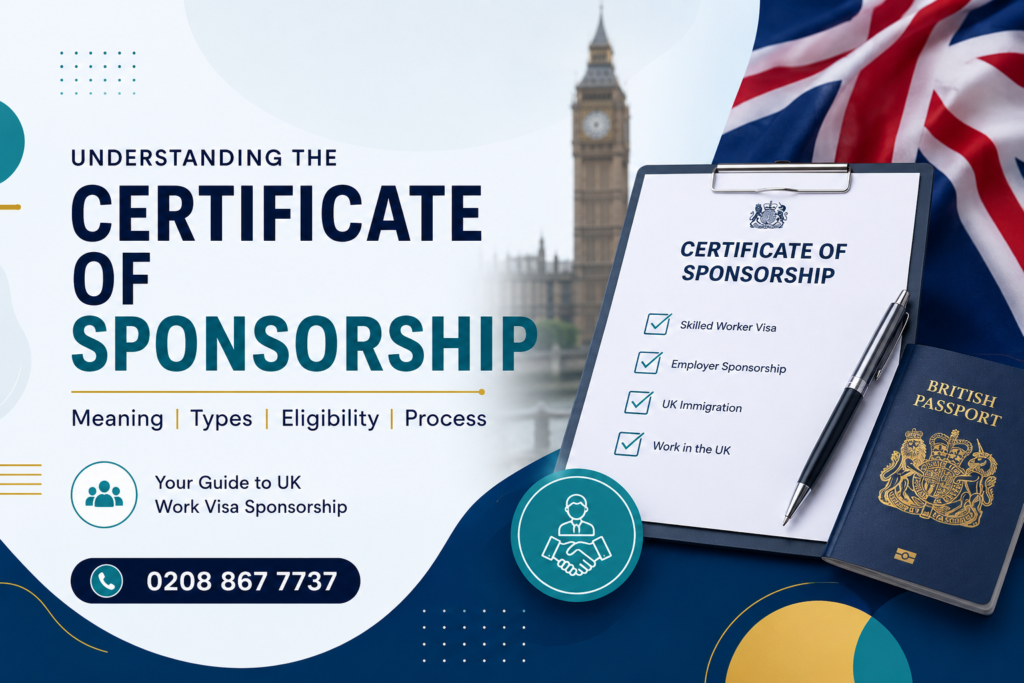
Certificate of Sponsorship Meaning: Everything You Need to Know in 2025 If you’re planning to work in the UK as an international worker, you’ve probably come across the term Certificate of Sponsorship (CoS). It’s a vital part of the UK visa application process, especially for skilled workers. But what exactly does it mean? Let us shed some light on it for better understanding. What Is a Certificate of Sponsorship in the UK? Certificate of Sponsorship in the UK for Skilled Worker Visa from in-country and out-of-country applicants: A Certificate of Sponsorship (CoS) is an official electronic document issued by a UK-licensed employer (also called a sponsor) to a foreign worker they intend to hire. It contains a unique reference number and important job-related information needed to apply for a Skilled Worker visa or other sponsored work visas. It’s not a physical certificate but a digital record created in the UK Home Office’s Sponsor Management System (SMS). Types of Certificates of Sponsorship (Certificate of Sponsorship Meaning) There are two main types: 1. Defined Certificate of Sponsorship Used for workers applying from outside the UK. Employers must request it for each candidate. 2. Undefined Certificate of Sponsorship Used for people already inside the UK for switching visa categories or extending their stay. What Information Does a CoS Contain? A CoS includes: How to Get a Certificate of Sponsorship? How to Get a Certificate of Sponsorship in the UK in 2025 To get a CoS: You cannot apply for a CoS yourself—it must be provided by your employer. Contact Asher & Tomar Solicitors (Certificate of Sponsorship Meaning), one of the best immigration solicitor firms in the UK, who have been serving since 2008. Our team of expert immigration solicitors has in-depth knowledge of the immigration laws/rules and can advise you thoroughly on what a Certificate of Sponsorship Meaning is? FAQs 1. What is a Certificate of Sponsorship (CoS)? A Certificate of Sponsorship is a digital reference number issued by a licensed UK employer to confirm they are sponsoring a migrant worker for a specific job. It’s not a physical document but an electronic record used when applying for a Skilled Worker Visa or other sponsored work visas. 2. Who can issue a Certificate of Sponsorship? Only employers who hold a valid Home Office Sponsor Licence can assign a CoS. They must meet strict compliance and reporting duties to maintain their licence and continue sponsoring overseas workers. 3. What information is included in a CoS? A CoS contains key details about the job and the worker, including job title, job description, salary, working hours, and the employer’s licence number. It also includes a unique reference code that the applicant must use in their visa application. 4. How long is a Certificate of Sponsorship valid for? Once assigned, a CoS is typically valid for three months. The visa application must be submitted within this timeframe, otherwise the certificate expires and may need to be reissued. 5. What is the difference between an Assigned and Unassigned CoS? An Unassigned CoS sits in the employer’s sponsorship management system until it is allocated to a specific worker. Once allocated, it becomes an Assigned CoS and can be used by the worker to apply for their visa. Read Article>>> UK Visa Sponsorship UK Dependent Visa
PR IN UK
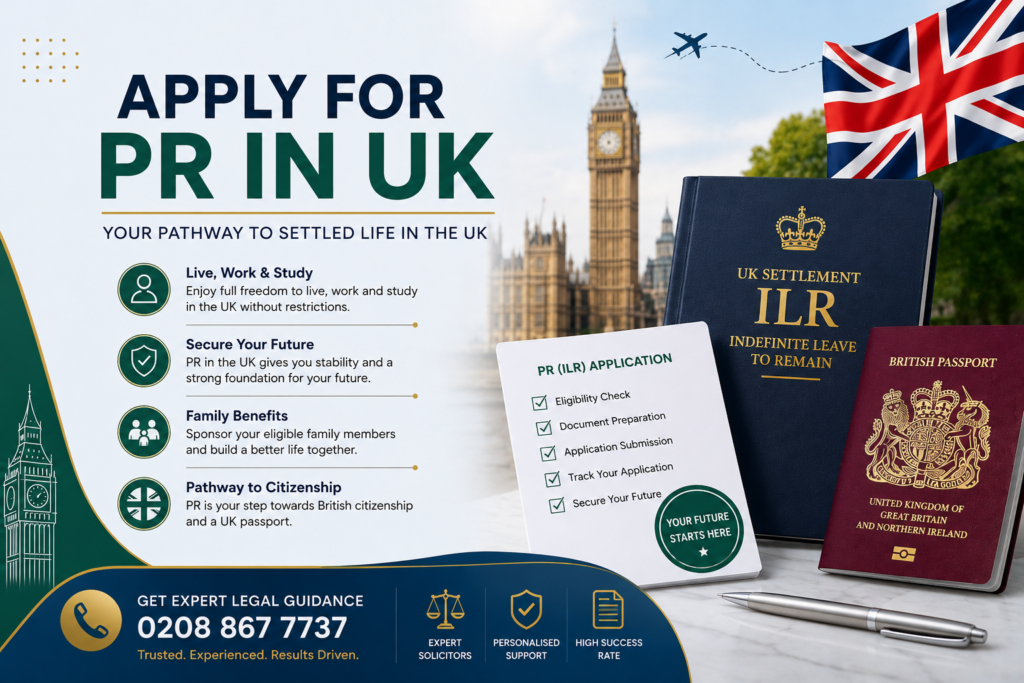
How to Get Permanent Residency (PR in UK) in the UK: Step-by-Step Guide for 2025 Getting Permanent Residency in the UK for international migrants is a significant milestone. Whether you’re on a skilled worker visa, student visa, or family route, understanding the eligibility and process is key to securing your future in the United Kingdom. What Is PR in the UK (PR in UK)? Permanent Residency (PR), officially known as Indefinite Leave to Remain (ILR) in the UK, allows non-UK citizens to live and work in the country without any time restrictions. Once granted, it is a pathway to British citizenship. How to Apply for PR in the UK for Skilled Workers Long-tail Keyword: How to get PR in the UK after 5 years on a Skilled Worker Visa If you are on a Skilled Worker Visa, you can usually apply for PR after 5 years of continuous residence in the UK. The main criteria include: PR in the UK for Students: Can International Students Get PR in the UK? How can international students get PR in the UK after studies? Yes, international students can apply for PR in the UK, but not directly after studies. The common route is: Family Route to PR in the UK Long-tail Keyword: How to get UK PR through spouse or family visa If you are in the UK as a spouse of a British citizen or a settled person, you may qualify for PR after 5 years of residence, provided: Documents Required to Apply for PR in the UK How Much Does PR Cost in the UK? As of 2025, the application fee for Indefinite Leave to Remain (ILR) is £2,885. Additional charges may include the biometric fee and optional services like premium processing. To find out in detail about PR in UK, contact our team of expert immigration solicitors in London, who have been serving since 2008. FAQs – Apply for PR in UK 1. What does PR in the UK mean? PR in the UK generally refers to Indefinite Leave to Remain (ILR), which allows individuals to live, work, and study in the UK without immigration restrictions. 2. Who can apply for PR in the UK? You may be eligible to apply for PR in the UK through routes such as the Skilled Worker visa, family visa, long residence, business immigration, or other qualifying categories. 3. How long does it take to get PR in the UK? Most applicants can apply for PR after 5 years of continuous lawful residence, although some routes require 10 years or have accelerated settlement options. 4. What documents are required to apply for PR in the UK? Common documents include your passport, BRP or eVisa details, proof of continuous residence, employment records, financial evidence, and English language and Life in the UK test certificates. 5. Is the Life in the UK Test mandatory for PR applications? Yes, most applicants aged 18 to 64 must pass the Life in the UK Test unless they qualify for an exemption. 6. Can I work in the UK after receiving PR? Yes. Once granted PR (ILR), you can work, change employers, start a business, or study in the UK without sponsorship requirements. 7. What is the difference between PR and British citizenship? PR (ILR) gives you permanent settlement rights, while British citizenship provides additional benefits, including a UK passport and voting rights in all elections. 8. Can family members apply for PR in the UK? Yes. Eligible spouses, partners, and dependent children may apply for settlement if they meet the relevant immigration requirements. 9. How much does it cost to apply for PR in the UK? The application fee depends on the latest Home Office charges and any additional services, such as priority processing. 10. Can an immigration solicitor help with a PR application? Yes. An experienced immigration solicitor can assess your eligibility, prepare supporting documents, and guide you through the PR application process to minimise delays and errors.
Returning Resident Visa
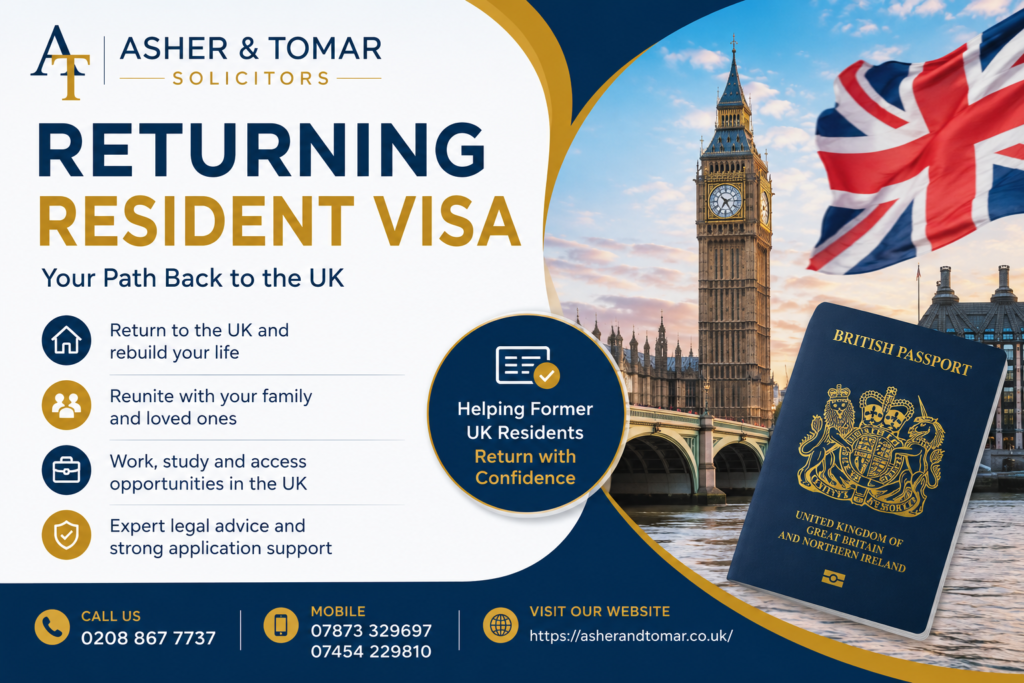
Returning Resident Visa: A Complete Guide to Returning to the UK If you have previously held settled status in the UK and wish to return after living abroad, a Returning Resident Visa may allow you to regain your right to live in the United Kingdom. This visa is designed for individuals who were previously granted Indefinite Leave to Remain (ILR) or settled status but lost it after spending an extended period outside the UK. Understanding the eligibility requirements and application process can improve your chances of a successful application. Seeking professional immigration advice can also help ensure that your evidence is presented effectively. What Is a Returning Resident Visa? A Returning Resident Visa allows former UK residents who previously held settled status to return to the UK and continue living, working, and studying without needing to apply for a different immigration route. If your ILR or settled status has lapsed because you remained outside the UK for too long, you may be eligible to apply as a returning resident. Who Can Apply? You may qualify for a Returning Resident Visa if you: Each application is assessed on its own merits, so supporting evidence is extremely important. Evidence You May Need Applicants should provide documents that support their application, including: Providing comprehensive documentation helps strengthen your application. How the Home Office Assesses Applications When considering a Returning Resident Visa application, the Home Office may look at: The stronger your evidence, the better your chances of success. Benefits of a Returning Resident Visa A successful Returning Resident Visa application offers several advantages: For many applicants, it provides the opportunity to resume life in the country they previously called home. Common Reasons Applications Are Refused Applications may be refused if: Preparing your application carefully can significantly reduce the risk of refusal. Why Professional Legal Advice Matters Immigration rules can be complex, particularly when applying for a Returning Resident Visa. An experienced immigration solicitor can: Professional legal support can improve both the quality of your application and your confidence throughout the process. How Asher & Tomar Solicitors Can Help At Asher & Tomar Solicitors, we provide expert immigration advice for individuals seeking a Returning Resident Visa. Our experienced legal team understands the Home Office requirements and works closely with clients to prepare strong applications supported by clear evidence. We are committed to delivering practical advice, personalised support, and professional representation throughout your immigration journey. Contact Asher & Tomar Solicitors Phone: 0208 867 7737Mobile: 07873 329697Mobile: 07454 229810 Website: https://asherandtomar.co.uk/ Contact our immigration team today to arrange a confidential consultation and discuss your Returning Resident Visa application. Frequently Asked Questions 1. What is a Returning Resident Visa? A Returning Resident Visa allows former UK residents who previously held settled status to return and live permanently in the UK after losing their ILR due to an extended absence. 2. Who is eligible for a Returning Resident Visa? Individuals who previously held Indefinite Leave to Remain or settled status and can demonstrate strong ties to the UK may be eligible. 3. What documents are required? Applicants may need passports, proof of previous settled status, travel records, family evidence, employment history, property documents, and financial records. 4. How long does the application process take? Processing times vary depending on the country of application and Home Office workload. 5. Can a solicitor help with my application? Yes. An experienced immigration solicitor can assess your eligibility, prepare your evidence, and submit a well-supported application.
How to Fill an AP1 form
How to Fill an AP1 form Explained: An AP1 form is used and submitted to the Land Registry to apply for a change to the register. It must be filed at the same time as a TP1 (transfer of part form) or TR1 (transfer of register form). Step-by-Step Guidance on Filling in an AP1 Form (How to Fill an AP1 form): Form AP1 is used to apply for changes to the Land Registry. For example, it may be used to add or remove a person from the register, correct or update an existing name, remove a mortgage that has been paid off, or transfer ownership to a surviving joint proprietor following the death of an owner, once probate has been granted. You can submit an AP1 application yourself; however, if the property is mortgaged, the lender may require you to instruct a conveyancer or solicitor. Guidance on completing Form AP1: Why Choose Asher and Tomar Solicitors for Your AP1 Application (How to Fill an AP1 Form)? Asher and Tomar Solicitors are regulated by the Solicitors Regulation Authority (SRA) and have been proudly serving clients since 2008. Over the years, we have successfully handled numerous AP1 applications with diligence and efficiency. Our experienced property law solicitors always act in the best interests of our clients, and we take great pride in the quality of our services. Our primary aim is to help you achieve your goal with a smooth and stress-free experience. Trust us to guide you through your AP1 application with professionalism, expertise, and a client-focused approach. So, if you are seeking any guidance about how to Fill an AP1 form, then contact our team of expert solicitors in London.
Spouse Visa Appeal: Your Complete Guide to Challenging a UK Spouse Visa Refusal
Receiving a refusal for your UK Spouse Visa application can be devastating, but it’s not the end of the road. You have the right to appeal the decision if you believe it was incorrect or unfair. In this comprehensive guide, we’ll walk you through the Spouse Visa appeal process, including grounds for appeal, required steps, and expert tips to strengthen your case. What is a Spouse Visa Appeal? A Spouse Visa appeal is a legal process that allows you to challenge a refusal decision made by the UK Home Office. If your application was denied due to errors, insufficient evidence, or misinterpretation of the rules, you can present your case to an independent tribunal for review. Grounds for a Spouse Visa Appeal To file a successful Spouse Visa appeal, you must have valid grounds. Common reasons for appeal include: 1. Incorrect Application of Immigration Rules 2. Insufficient Evidence 3. Human Rights Violations 4. Procedural Errors The Spouse Visa Appeal Process The Spouse Visa appeal process involves several steps. Here’s a detailed breakdown: Step 1: Receive the Refusal Letter Step 2: Lodge an Appeal Step 3: Prepare Your Case Step 4: Attend the Hearing Step 5: Receive the Decision Documents Required for a Spouse Visa Appeal To strengthen your appeal, you’ll need to provide the following documents: 1. Refusal Letter 2. Grounds of Appeal 3. Additional Evidence 4. Witness Statements 5. Legal Submissions Tips for a Successful Spouse Visa Appeal Common Reasons for Spouse Visa Refusals Understanding why applications are refused can help you avoid mistakes. Common reasons include: 10 Frequently Asked Questions (FAQs) About Spouse Visa Appeals 1. Can I appeal a UK Spouse Visa refusal? Yes, if your refusal letter states that you have the right to appeal. 2. How long do I have to file an appeal? You must file within 28 days (14 days if you’re in the UK). 3. What are the grounds for a Spouse Visa appeal? Common grounds include incorrect application of rules, insufficient evidence, human rights violations, and procedural errors. 4. Can I submit new evidence during the appeal? Yes, you can provide additional evidence to address the reasons for refusal. 5. Do I need a solicitor for a Spouse Visa appeal? While not mandatory, a solicitor can significantly improve your chances of success. 6. How long does the appeal process take? It can take several months, depending on the complexity of your case and tribunal availability. 7. What happens if my appeal is successful? The Home Office will reconsider your application in line with the tribunal’s decision. 8. Can I withdraw my appeal? Yes, you can withdraw your appeal at any time before the hearing. 9. What if my appeal is dismissed? You may be able to apply for permission to appeal to the Upper Tribunal, depending on the circumstances. 10. Can I reapply instead of appealing? Yes, you can reapply if you believe you can address the reasons for refusal in a new application.
UK Spouse Visa Requirements: Your Complete Guide
The UK Spouse Visa is a popular immigration route for individuals who wish to join their British or settled partner in the United Kingdom. However, meeting the UK Spouse Visa requirements is essential for a successful application. In this comprehensive guide, we’ll explore the eligibility criteria, financial requirements, necessary documents, and other key aspects of the UK Spouse Visa application process. What Are the UK Spouse Visa Requirements? The UK Spouse Visa requirements are designed to ensure that applicants meet specific criteria related to their relationship, financial stability, and ability to integrate into UK society. Below, we’ll break down each of these requirements in detail. 1. Relationship Requirements for a UK Spouse Visa The UK Home Office places significant emphasis on the genuineness of your relationship. To meet the UK Spouse Visa relationship requirements, you must: a. Be Legally Married or in a Civil Partnership b. Prove Your Relationship is Genuine and Subsisting You’ll need to provide evidence that your relationship is genuine and that you intend to live together permanently in the UK. Examples of evidence include: 2. Financial Requirements for a UK Spouse Visa One of the most critical aspects of the UK Spouse Visa application is meeting the financial requirement. The sponsoring partner must demonstrate a minimum annual income of £18,600. This threshold increases if you have dependent children: How to Meet the Financial Requirement You can meet the financial requirement through various means, including: a. Employment Income b. Self-Employment Income c. Savings d. Other Income Sources 3. English Language Requirement for a UK Spouse Visa Applicants must prove their knowledge of the English language by: This requirement ensures that applicants can integrate into UK society and communicate effectively. 4. Accommodation Requirements for a UK Spouse Visa You must demonstrate that you have adequate accommodation in the UK without relying on public funds. This means: 5. Genuine Intent to Live Together The UK Home Office will assess whether you and your partner genuinely intend to live together permanently in the UK. This is a key part of the UK Spouse Visa requirements, and you’ll need to provide evidence to support this claim. Documents Required for a UK Spouse Visa Application To demonstrate your eligibility for a UK Spouse Visa, you’ll need to submit a range of documents. These include: a. Relationship Documents b. Financial Documents c. English Language Proof d. Accommodation Documents e. Additional Documents Common Reasons for Failing UK Spouse Visa Requirements Understanding the common reasons for failing eligibility can help you avoid mistakes. Some of the most common reasons include: Tips for Meeting UK Spouse Visa Requirements 10 Frequently Asked Questions (FAQs) About UK Spouse Visa Requirements 1. What is the minimum income requirement for a UK Spouse Visa? The minimum income requirement is £18,600 per year, increasing if you have dependent children. 2. Can I use savings to meet the financial requirement? Yes, you can use savings of at least £62,500 held for six months. 3. What evidence do I need to prove my relationship? You’ll need photos, travel itineraries, communication records, and joint financial commitments. 4. Is there an English language requirement for a UK Spouse Visa? Yes, you must pass an approved English test or hold a degree taught in English. 5. How long does a UK Spouse Visa last? A UK Spouse Visa is initially valid for 2.5 years and can be extended. 6. Can I work in the UK on a Spouse Visa? Yes, you can work in the UK without restrictions on a Spouse Visa. 7. What happens if my application is refused? You can appeal the decision or reapply, addressing the reasons for refusal. 8. Can I apply for a UK Spouse Visa from within the UK? Yes, you can apply from within the UK if you meet the eligibility criteria. 9. How long does it take to process a UK Spouse Visa? Processing times are up to 12 weeks from outside the UK and up to 8 weeks from within the UK. 10. Do I need a solicitor to apply for a UK Spouse Visa? While not mandatory, a solicitor can help you navigate the process and avoid mistakes.
Spouse Visa Processing Time: Your Complete Guide
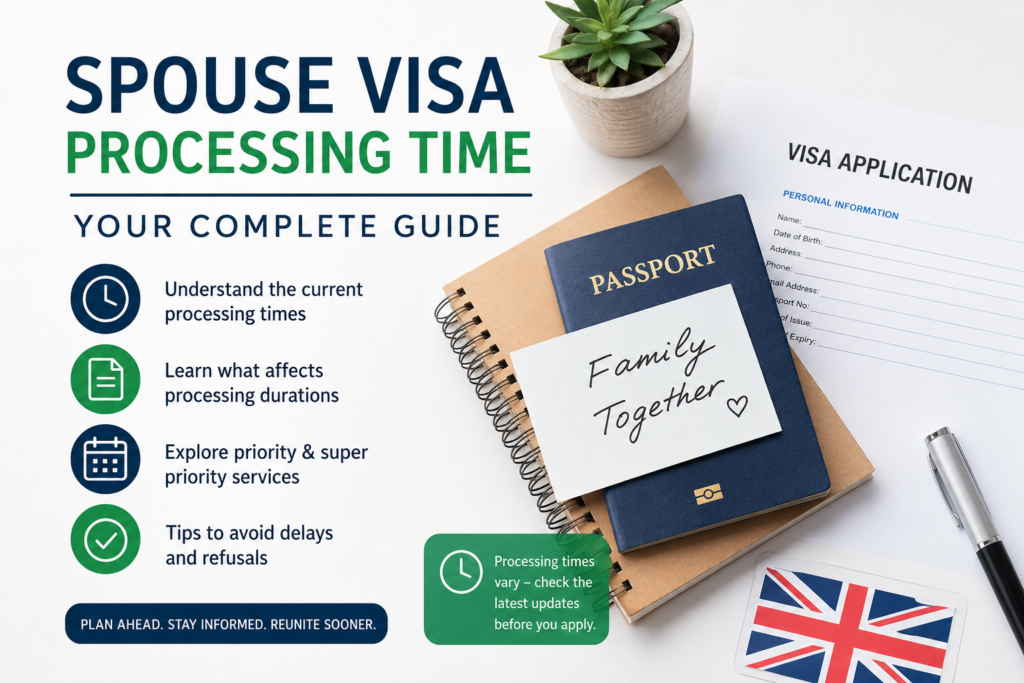
Applying for a Spouse Visa is a significant step towards reuniting with your partner in the United Kingdom. However, understanding the Spouse Visa processing time is crucial to manage your expectations and plan accordingly. In this comprehensive guide, we’ll explore the standard processing times, priority services, and factors that can cause delays in the Spouse Visa application process. What is the Spouse Visa Processing Time? The Spouse Visa processing time refers to the period it takes for the UK Home Office to review and make a decision on your Spouse Visa application. This timeline can vary depending on whether you’re applying from inside or outside the UK, the complexity of your case, and the type of service you choose. Standard Spouse Visa Processing Time The standard processing time for a Spouse Visa depends on where you’re applying from: 1. Applying from Outside the UK 2. Applying from Inside the UK These timelines are based on the UK Home Office’s published service standards and can vary depending on the volume of applications and other factors. Priority and Super Priority Services If you need a faster decision, you can opt for priority or super priority services, which come at an additional cost. 1. Priority Service 2. Super Priority Service These services are subject to availability and may not be offered in all countries. Factors That Can Affect Spouse Visa Processing Time Several factors can influence the Spouse Visa processing time, including: 1. Application Complexity 2. Incomplete or Incorrect Applications 3. High Application Volume 4. Additional Checks 5. Country-Specific Factors How to Track Your Spouse Visa Application Once you’ve submitted your application, you can track its progress through the following methods: 1. Online Tracking 2. Contacting the Home Office 3. Visa Application Center Tips to Avoid Delays in Spouse Visa Processing Time To ensure your Spouse Visa application is processed as quickly as possible, follow these tips: 1. Submit a Complete Application 2. Double-Check Your Documents 3. Provide Strong Evidence of Your Relationship 4. Meet the Financial Requirement 5. Seek Professional Advice What to Do If Your Spouse Visa Processing Time is Delayed If your Spouse Visa processing time exceeds the standard timeline, you can take the following steps: 1. Contact the Home Office 2. Seek Professional Help 3. Be Patient FAQs – Spouse Visa Processing Time 1. How long does a UK spouse visa take to process? Processing times vary depending on where the application is submitted and the complexity of the case. Most standard applications are processed within the Home Office’s published service standards, although individual circumstances can affect timelines. 2. Can I speed up my spouse visa application? Yes. Depending on availability and location, applicants may be able to use priority or super-priority services to receive a faster decision. Additional fees usually apply. 3. What factors can delay a spouse visa application? Common causes of delays include missing documents, insufficient financial evidence, incomplete application forms, requests for additional information, and high application volumes. 4. Does a previous visa refusal affect processing times? A previous refusal may lead to additional scrutiny of the application, which could increase the overall processing time. Proper legal preparation can help reduce complications. 5. How can I check the status of my spouse visa application? Applicants can usually track their application through the visa application centre or the official online application system used during submission. 6. Will submitting extra documents speed up the process? Providing complete and accurate supporting documents at the time of submission can help avoid delays, but submitting unnecessary documents generally does not accelerate processing. 7. What happens if the Home Office requests additional information? If further evidence is requested, applicants should respond promptly. Delays in providing the requested information can extend processing times. 8. Can I travel while my spouse visa application is being processed? This depends on where the application is submitted and individual circumstances. In many cases, applicants should avoid travel plans until a decision has been made. 9. Do priority spouse visa applications guarantee approval? No. Priority services only aim to provide a faster decision. The application must still satisfy all eligibility and documentary requirements. 10. How can an immigration solicitor help with spouse visa processing? An experienced immigration solicitor can ensure that your application is properly prepared, all required documents are included, and potential issues are addressed before submission, helping to reduce the risk of delays or refusal.