
How to Organise Relationship Documents for a UK Spouse Visa
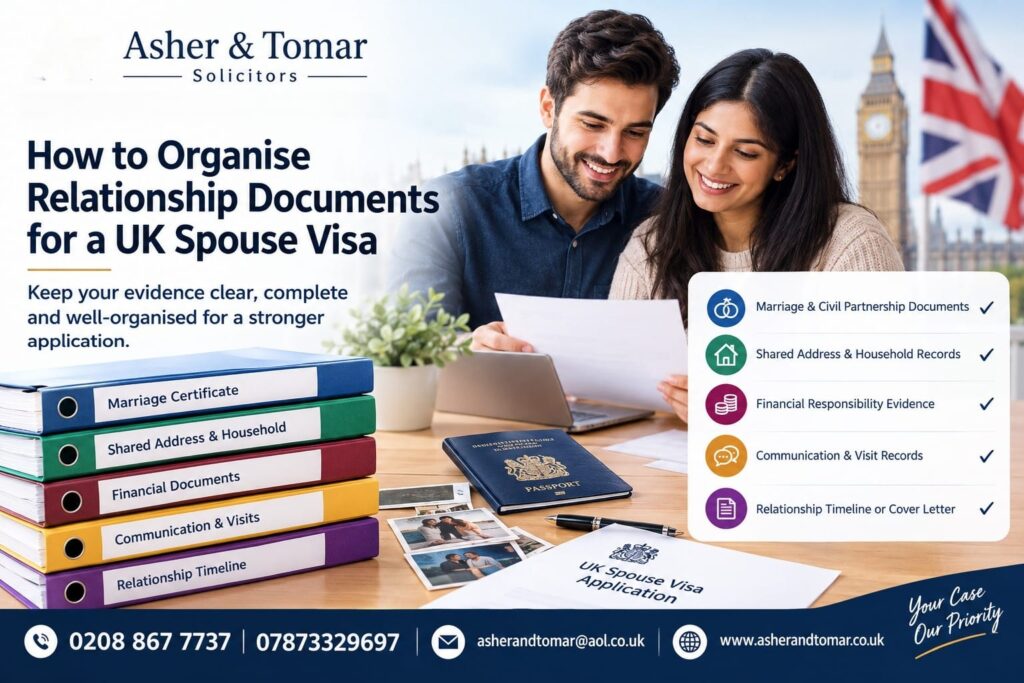
Applying for a UK spouse visa involves more than completing an application form. Applicants must provide suitable documents to demonstrate that their relationship is genuine and ongoing, alongside evidence meeting the other relevant immigration requirements. Organising these documents carefully can make the application easier to review and help reduce the risk of missing important information. Whether you are applying from India, another country or within the UK, preparing your relationship evidence in a clear and logical order is an important part of the process. Marriage certificates, shared-address records, financial documents, photographs and communication records may all help explain your relationship, depending on your circumstances. At Asher & Tomar Solicitors, we understand that every couple has a different relationship history. This guide explains how to organise relationship documents for a UK spouse visa, what evidence you may wish to include and which common mistakes to avoid. Why Is It Important to Organise Relationship Documents for a UK Spouse Visa? A well-organised application helps present your relationship history clearly. Instead of submitting a large collection of unrelated documents, you can arrange relevant evidence so that dates, addresses and details are easy to understand. UK Visas and Immigration assesses the evidence available in each case. There is no single document that guarantees acceptance of a relationship, and the Home Office considers the overall circumstances when assessing whether a relationship is genuine and continuing. Organising your documents can help you present your relationship history chronologically, make important milestones easier to identify, demonstrate periods of living together or apart, identify missing documents before submission and reduce unnecessary duplication. Your documents should be genuine, relevant and consistent with the information provided in your application form. Create a UK Spouse Visa Relationship Documents Checklist Before scanning or uploading any documents, create a checklist of the evidence you have and the evidence you may still need to obtain. Your checklist should reflect your relationship circumstances, whether you live together, have spent periods apart or have recently married. Marriage or Civil Partnership Documents Start with your marriage certificate or civil partnership certificate, where applicable. Check that names, dates and other details are accurate and consistent with your application. If your marriage certificate or another supporting document is not in English or Welsh, you will generally need to provide a suitable certified translation in accordance with the relevant application guidance. You may also need documents explaining previous marriages or civil partnerships that have ended, if relevant to your circumstances. Shared Address and Household Documents If you live together, gather suitable documents showing your shared address. Depending on your circumstances, these might include joint tenancy agreements, mortgage documents, Council Tax bills, utility bills, joint bank statements and official correspondence addressed to each partner at the same address. Where possible, choose genuine, dated documents that cover an appropriate period and help establish the history of your shared household. Communication and Visit Records If you and your spouse live in different countries or have spent time apart, you may need to explain how your relationship has continued. Relevant evidence may include selected communication records, travel documents, visit records and evidence of time spent together. Choose representative examples rather than uploading an unnecessarily large number of similar screenshots. Arrange Your Relationship Evidence Chronologically One of the simplest ways to organise spouse visa relationship evidence is to put it in date order. Start with the beginning of your relationship and move towards the date of your application. Include key milestones where relevant, such as when you met, became engaged, married, began living together or visited each other. For example, your evidence may begin with selected photographs, travel records or other documents showing how your relationship developed. Engagement records, wedding photographs and your marriage certificate can follow, where applicable. Documents relating to your life together, such as joint tenancy agreements, household bills, bank statements and official correspondence, can demonstrate shared responsibilities. For couples living apart, selected call or message records and travel evidence may help explain how the relationship has continued. Finish with relevant recent evidence that helps demonstrate that the relationship remains ongoing. You do not need to provide every document from every stage of your relationship. The aim is to create a coherent and truthful picture supported by suitable evidence. Separate Documents Into Clear Categories After putting your records in date order, group them into categories. This makes it easier to identify the purpose of each document and prevents unrelated evidence from becoming mixed together. Marriage and Relationship History Include the marriage certificate, relevant records of your engagement and selected evidence of important relationship milestones. Shared Residence Place tenancy agreements, Council Tax bills, utility bills and relevant official correspondence in this section. If you have lived at different addresses, make sure the documents reflect your actual circumstances. Explain any significant periods apart where necessary. Joint Financial Responsibilities Include relevant evidence of shared financial commitments, such as joint bank statements, shared household expenses or joint financial agreements, where available. You should not create artificial financial arrangements or assume that a joint account is compulsory. The appropriate evidence depends on your circumstances. Communication and Visits For couples who have lived apart, include selected evidence of regular communication, visits and shared experiences. Make sure dates are visible where possible and that the records are genuine. Supporting Explanation If there are unusual circumstances, a short relationship timeline or explanatory statement may help clarify them. For example, you may need to explain why you lived apart temporarily because of work, study or family responsibilities. Any explanation should be factual and consistent with the supporting documents. Check Dates, Names and Addresses Carefully Consistency is important when preparing a UK spouse visa application. Review the information in your documents alongside the details entered in the application form. Check that both partners’ names are spelled correctly, dates of birth and marriage dates are accurate, previous and current addresses are recorded correctly, and periods of living together or apart are explained where necessary. Travel dates should not conflict with your relationship timeline.
Proof of Relationship for UK Spouse Visa: Documents You Need to Provide
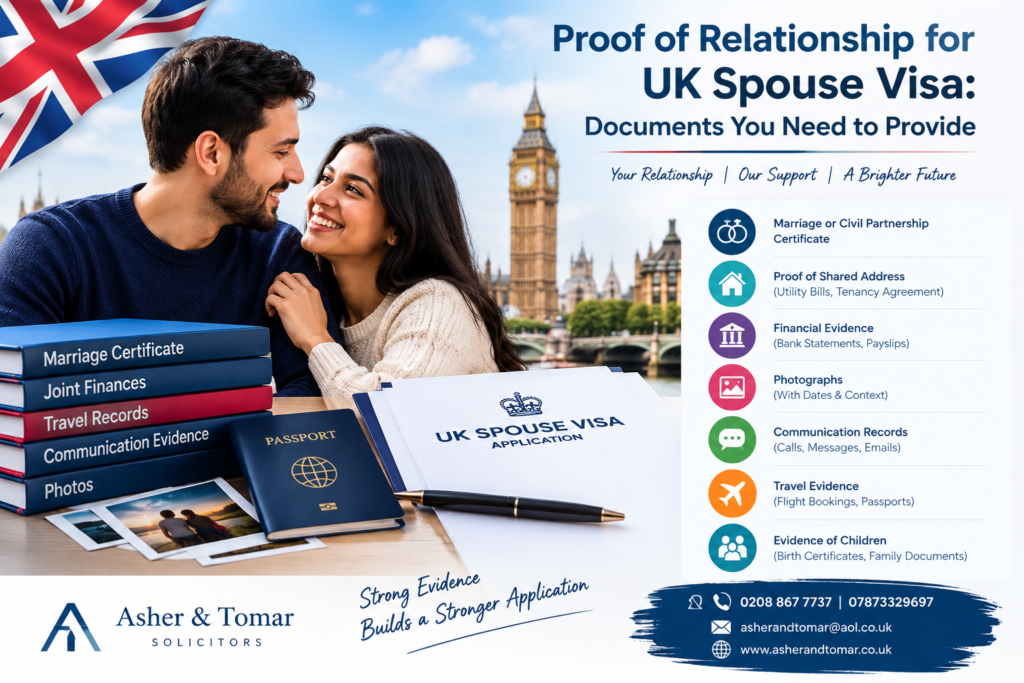
Proof of Relationship for UK Spouse Visa: Documents You Need to Provide Applying for a UK spouse visa involves more than submitting a marriage certificate. Applicants must meet the relevant immigration requirements, including demonstrating that their relationship with their partner is genuine and continuing. Preparing suitable relationship evidence can help explain how the relationship began, how it developed and how the couple maintains their commitment to one another. For couples applying from overseas, including applicants from India, gathering documents can sometimes be challenging, particularly when partners have spent periods living in different countries. Understanding the types of evidence that may support an application can help couples prepare a clearer and more organised submission. Asher & Tomar Solicitors can provide immigration guidance tailored to individual circumstances and the evidence available. Why Is Proof of Relationship Important for a UK Spouse Visa? UK spouse visa applications are assessed against the applicable Immigration Rules. Applicants generally need to demonstrate that their marriage or civil partnership is valid and that their relationship is genuine and subsisting. The Home Office may consider the information supplied in the application, supporting documents and other relevant circumstances when assessing the relationship. A marriage certificate is important evidence of a legal marriage, but additional documents may help demonstrate the ongoing nature of the relationship. For example, evidence of living together, shared financial responsibilities, visits, communication and family commitments may help explain the couple’s circumstances. There is no single document that guarantees approval. The appropriate evidence depends on the individual application, the couple’s history and whether they live together or apart. Documents That Can Help Prove a Genuine Relationship Marriage Certificate or Civil Partnership Certificate A marriage certificate is a key document for applicants relying on a marriage to qualify for a spouse visa. It should identify both partners and provide evidence that the marriage was legally registered or recognised. Couples married outside the UK should ensure that their marriage documentation is valid and suitable for the application. If the certificate is not in English or Welsh, a certified translation may be required. Applicants should check the relevant document guidance and ensure that names, dates and other details are consistent across their paperwork. Joint Tenancy Agreements and Proof of Shared Address Documents showing that partners have lived together can help demonstrate the development and continuity of their relationship. Depending on the circumstances, relevant evidence may include joint tenancy agreements, mortgage documents, council tax bills, utility bills or official correspondence addressed to both partners at the same address. Where bills or official documents are issued in separate names, records showing that both partners have lived at the same address over time may also be helpful. Couples who have not lived together should not assume that their application cannot succeed. Their circumstances and the reasons for living apart should be explained accurately. Joint Bank Accounts and Shared Financial Commitments Financial documents may help demonstrate that a couple shares responsibilities or makes practical arrangements together. Examples include joint bank statements, joint insurance policies, mortgage statements, shared household expenses or records of financial support where relevant. Not every married couple maintains a joint bank account. Separate finances do not automatically mean that a relationship is not genuine. Applicants should provide evidence that reflects their real circumstances rather than opening accounts or creating arrangements solely to strengthen an application. Photographs Showing Time Spent Together Photographs can help illustrate a couple’s relationship history. Suitable examples may include wedding photographs, family celebrations, holidays, visits and other meaningful occasions spent together. Photographs are generally more useful when presented selectively and accompanied by brief context, such as the date, location and people shown. A large collection of similar images may add little value if it does not help explain the relationship. Photographs should support the wider evidence rather than serve as the only proof of a genuine relationship.Communication Records for Couples Living Apart Couples who live in different countries may use communication records to demonstrate that they maintain regular contact. Relevant material could include selected call logs, message records, emails or video-call histories. It is usually more helpful to present a representative selection covering relevant periods than to submit extensive, repetitive conversations. The evidence should be genuine, appropriately dated and consistent with the relationship history described in the application. Couples should protect private information that is not relevant to the application. Travel Records and Visits Travel evidence can help demonstrate that partners have made efforts to spend time together despite living apart. Depending on the circumstances, this may include flight bookings, passport entry stamps, boarding passes, hotel reservations or other records of visits. These documents may be particularly relevant when work commitments, study, immigration restrictions or family responsibilities prevent a couple from living together continuously. Explain the dates and purpose of important visits where this helps clarify the relationship timeline. Evidence of Children and Family Responsibilities Where a couple has children together, relevant birth certificates and documents showing shared parental responsibilities may help explain their family circumstances. Other appropriate evidence might include records relating to childcare, education or shared arrangements for the children’s welfare. Only provide documents that are relevant to the application and handle children’s personal information carefully. The evidence should be consistent with the information provided on the application form. How to Prove Your Relationship If You Live in Different Countries Living apart does not automatically mean that a relationship is not genuine. Couples may live separately because of employment, education, immigration restrictions, caring responsibilities or cultural and family circumstances. In these cases, the application can explain why the couple lives apart, how long the arrangement has continued and what steps they take to maintain their relationship. Communication records, travel evidence, shared financial commitments and plans for living together may help provide context. Applicants should avoid assuming that every couple must provide the same documents. The Home Office considers the available evidence and individual circumstances. A clear, truthful explanation can be particularly important where conventional evidence, such as joint bills or a shared tenancy agreement, is
Spouse Visa Cost UK: Complete Breakdown of Fees and Expenses in 2026
Spouse Visa Cost UK: Understanding the Total Expense in 2026 Understanding the Spouse Visa Cost UK is essential for couples planning to live together in the United Kingdom. Whether you are applying from overseas to join your British or settled partner or extending your existing permission to remain in the UK, knowing the likely expenses can help you prepare financially and avoid unexpected costs. The total cost is not limited to the visa application fee. Applicants may also need to pay the Immigration Health Surcharge (IHS), English language test fees, document translation costs and optional priority processing charges. If you choose professional legal assistance, solicitor fees will add to your budget. For 2026, the standard spouse or partner family visa application fee is £2,064 when applying from outside the UK and £1,407 when applying from inside the UK. The Immigration Health Surcharge is charged separately where applicable. <Cite refs={[“turn867573search0″,”turn867573search3”]}/> The exact amount you pay depends on your application location, visa duration, family circumstances and the services you choose. Spouse Visa Cost UK: Application Fees for 2026 The government application fee is the primary charge paid to UK Visas and Immigration (UKVI) when submitting an eligible spouse or partner visa application. Application type Standard application fee Initial spouse visa from outside the UK £2,064 Spouse visa extension or eligible switch from inside the UK £1,407 These figures relate to the standard family visa route for joining or remaining with a partner. Different immigration categories may have different charges. The application fee covers the processing of the immigration application, not every expense associated with obtaining permission to live in the UK. It does not normally include the Immigration Health Surcharge, legal representation or optional premium services. Applicants should confirm the current fee through official government guidance before submitting their application. Spouse Visa Cost UK: Immigration Health Surcharge Explained The Immigration Health Surcharge is a separate charge that most applicants on the standard spouse visa route must pay. It is generally required for eligible immigration applications involving permission to stay for more than six months from overseas or applications made inside the UK, subject to the applicable rules and exemptions. The standard adult surcharge is £1,035 per year. The amount depends on the period of immigration permission requested. For a typical initial spouse visa granted for approximately 2 years and 9 months, the adult IHS is £3,105. For a standard 30-month extension inside the UK, it is £2,587.50. <Cite refs={[“turn867573search0″,”turn867573search5”]}/> The surcharge is normally paid upfront. It contributes towards access to NHS healthcare during the relevant period, subject to the applicable healthcare rules. Private medical insurance does not generally remove the requirement to pay the IHS. Spouse Visa Cost UK: Total Estimated Government Fees The following examples show how the standard application fee and IHS combine for one adult. Application route Application fee IHS Combined total Initial application from outside the UK, typically 2 years and 9 months £2,064 £3,105 £5,169 Extension from inside the UK for 30 months £1,407 £2,587.50 £3,994.50 These totals exclude solicitor fees, optional priority processing, translations, English language testing and other individual expenses. They assume the standard fees and surcharge periods shown apply to your case. <Cite refs={[“turn867573search0″,”turn867573search3”]}/> An initial overseas application and an in-country extension are not the same process. Check the route applicable to your circumstances rather than using the lower extension figure to budget for an initial application. Spouse Visa Cost UK: Priority Processing and Optional Services Some applicants may be able to pay an additional fee for faster processing. Availability depends on the application location, route and services offered when applying. For eligible applications, optional priority services may cost approximately £500, while super-priority processing may cost £1,000. The exact options and decision targets should be checked before payment. <Cite refs={[“turn867573search2″,”turn867573search8”]}/> For example, if a £500 priority service is available for an initial overseas application, the illustrative total would be £5,669, including the £2,064 application fee and £3,105 IHS. A £1,000 service would bring the total to £6,169. For a standard in-country extension, adding a £1,000 super-priority service to the £3,994.50 government total would bring the illustrative amount to £4,994.50. These examples exclude all other costs. Paying for a faster service does not guarantee that the visa will be approved. Spouse Visa Cost UK: Solicitor Fees and Professional Legal Advice Solicitor fees are separate from government charges and vary according to the firm’s pricing structure and the complexity of the application. Professional support may include checking eligibility, reviewing financial evidence, assessing relationship documents, explaining immigration requirements and helping applicants prepare their submissions. More complicated cases may require additional work. Before instructing a solicitor, request a written quotation explaining what is included. Ask whether VAT, disbursements and any work required after submission are charged separately. Although legal representation is not compulsory for every spouse visa application, advice may be helpful where there has been a previous refusal, financial circumstances are complicated or the applicant is uncertain about the relevant immigration rules. Spouse Visa Cost UK: English Tests and Document Preparation Applicants may need to budget for supporting documents and other requirements that are not included in the government application fee. English language test: If you must take an approved test and cannot rely on an exemption or alternative accepted evidence, the test fee is an additional expense. Document translation: Documents not written in English or Welsh may require suitable translations. Prices depend on the language, length and provider. Certificates and official records: Obtaining replacement marriage certificates, financial records or other supporting evidence may involve additional charges. Appointment-related services: Some application centres offer optional services, such as document scanning, courier delivery or premium appointments. Check whether these are necessary or voluntary. Planning for these expenses in advance can help you avoid unnecessary payments and prepare a more realistic budget. Spouse Visa Cost UK: Financial and Eligibility Requirements Paying the required fees does not automatically qualify an applicant for a spouse visa. Applicants must also satisfy the relevant immigration requirements. These may include demonstrating that the relationship
Total Cost of UK Spouse Visa for 2.5 Years in 2026: Complete Fees Guide for 2026
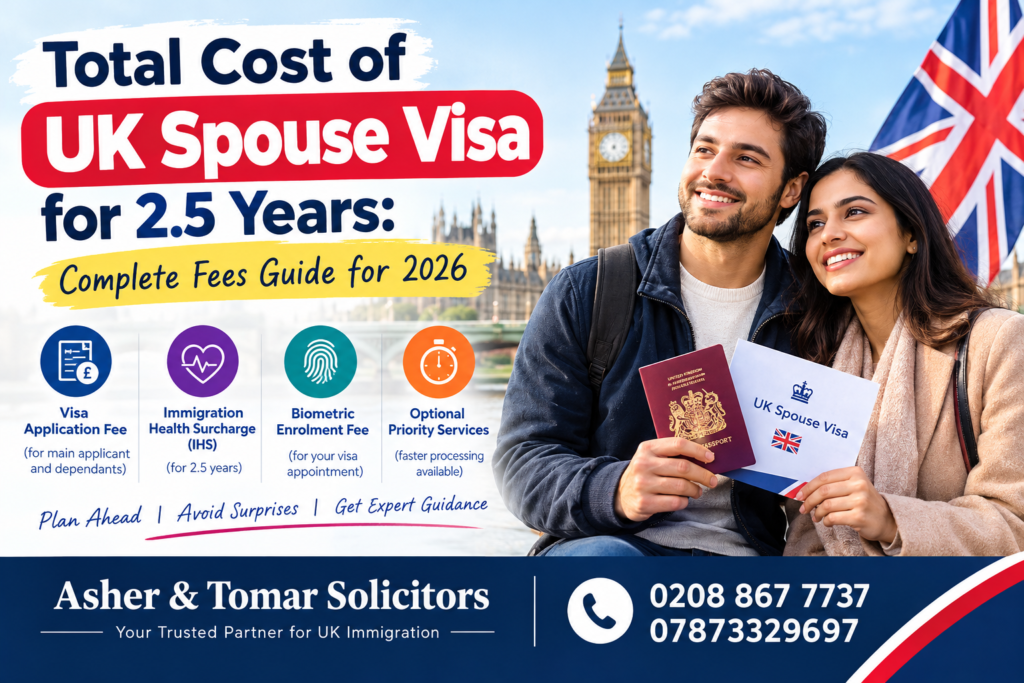
Total Cost of UK Spouse Visa for 2.5 Years in 2026: What Applicants Need to Know Understanding the total cost of UK spouse visa for 2.5 years in 2026 is essential for couples planning to continue their life together in the United Kingdom. Whether you are preparing to extend your existing spouse visa or reviewing your long-term immigration budget, knowing the government fees and additional expenses can help you plan your application more effectively. A standard spouse visa extension from inside the UK generally provides a further period of 30 months, equivalent to 2.5 years, for eligible applicants. The overall cost normally includes the visa application fee and the Immigration Health Surcharge (IHS). Other expenses, such as legal advice, English language testing where required, document translations and optional faster processing, may increase the total. For 2026, the standard government application fee for an eligible in-country partner or spouse extension is £1,407. The Immigration Health Surcharge for an adult applying for 2.5 years is £2,587.50. This brings the combined mandatory government charges to £3,994.50 for one adult, before any additional services or professional fees. Total Cost of UK Spouse Visa for 2.5 Years in 2026: Complete Fee Breakdown Applicants should understand how each charge contributes to the final amount payable. Fee component Cost Spouse visa extension application fee £1,407 Immigration Health Surcharge for 30 months £2,587.50 Total mandatory government charges £3,994.50 These figures apply to a standard adult application to extend or switch to the relevant family visa route from inside the UK, assuming the full 30-month period and standard charges apply. The total does not include solicitor fees, optional priority processing, document translations, English language tests or other individual expenses. Always verify the latest charges on the official GOV.UK website before submitting your application. Total Cost of UK Spouse Visa for 2.5 Years in 2026: Understanding the Application Fee The spouse visa extension application fee is the amount paid to UK Visas and Immigration (UKVI) to process the relevant immigration application. For a standard in-country partner or spouse application, the published fee is £1,407. This payment is required when submitting an eligible application unless a specific exemption or fee-waiver arrangement applies. Applicants should check their circumstances carefully because different immigration routes can have different fees and eligibility rules. The application fee covers the government processing of the immigration application. It does not automatically include professional legal assistance, document translation, optional appointment services or the Immigration Health Surcharge. Paying the fee does not guarantee approval. UKVI assesses whether the applicant meets the applicable immigration requirements and has provided sufficient supporting evidence. Total Cost of UK Spouse Visa for 2.5 Years in 2026: Immigration Health Surcharge Explained The Immigration Health Surcharge is a separate government charge that most applicants on the standard spouse visa route must pay when extending their permission to remain in the UK. The standard adult rate is £1,035 per year. For a 30-month period, the surcharge amounts to £2,587.50. This charge is generally paid upfront as part of the online application process. It contributes towards access to NHS healthcare during the relevant immigration permission period, subject to applicable healthcare rules and any relevant exemptions. The surcharge is not a payment for private medical insurance, nor is it usually calculated according to how frequently an individual uses NHS services. It is an immigration-related charge based on the applicable rate and period of permission. Applicants should budget for this amount separately from the application fee because it represents a substantial proportion of the overall expense. Total Cost of UK Spouse Visa for 2.5 Years: Optional Priority Processing Fees Some applicants may be able to pay for a faster decision service when applying from inside the UK. Availability depends on the application route and the options offered at the time of submission. The published optional in-country fees include: If the £500 priority service is available and selected, the illustrative combined total becomes £4,494.50. If the £1,000 super-priority service is available and selected, the combined total becomes £4,994.50. These amounts include the standard application fee and the 30-month IHS, plus the respective optional processing charge. They exclude legal and other additional expenses. Faster processing does not guarantee a successful application. Applicants should check current availability, the stated decision target and the conditions of the chosen service before paying. Total Cost of UK Spouse Visa for 2.5 Years in 2026: Solicitor Fees and Legal Advice Solicitor fees are separate from government immigration charges. The amount depends on the complexity of the application, the assistance requested and the firm’s fee structure. Some applicants prepare and submit their own applications. Others prefer professional support to review eligibility, assess financial evidence, organise relationship documents and identify potential concerns before submission. Legal assistance may be particularly useful if you have experienced a previous refusal, have complicated financial circumstances, need to rely on specific immigration provisions or are uncertain about the evidence required. Before instructing a solicitor, request a written explanation of the services included in the quotation. Check whether VAT, disbursements, further correspondence or additional work are charged separately. There is no single solicitor fee that applies to every spouse visa extension, so applicants should obtain an individual quotation rather than assume that legal services are included in the government total. Total Cost of UK Spouse Visa for 2.5 Years in 2026: Additional Expenses to Consider Although the standard government charges total £3,994.50, individual applications may involve other costs. English language testing: An applicant may need to demonstrate the required English language ability unless an exemption or accepted alternative applies. The test cost depends on the provider and test selected. Document translations: Documents that are not in English or Welsh may need suitable translations. Translation charges vary according to the document, language and service provider. Supporting documents: Applicants may incur costs obtaining replacement certificates, official records or other evidence required for their circumstances. Appointment-related services: Some visa application or identity verification services may offer optional paid extras. Check which services are necessary and which are voluntary.
What Is Included in the UK Spouse Visa Application Fee? A Complete Guide
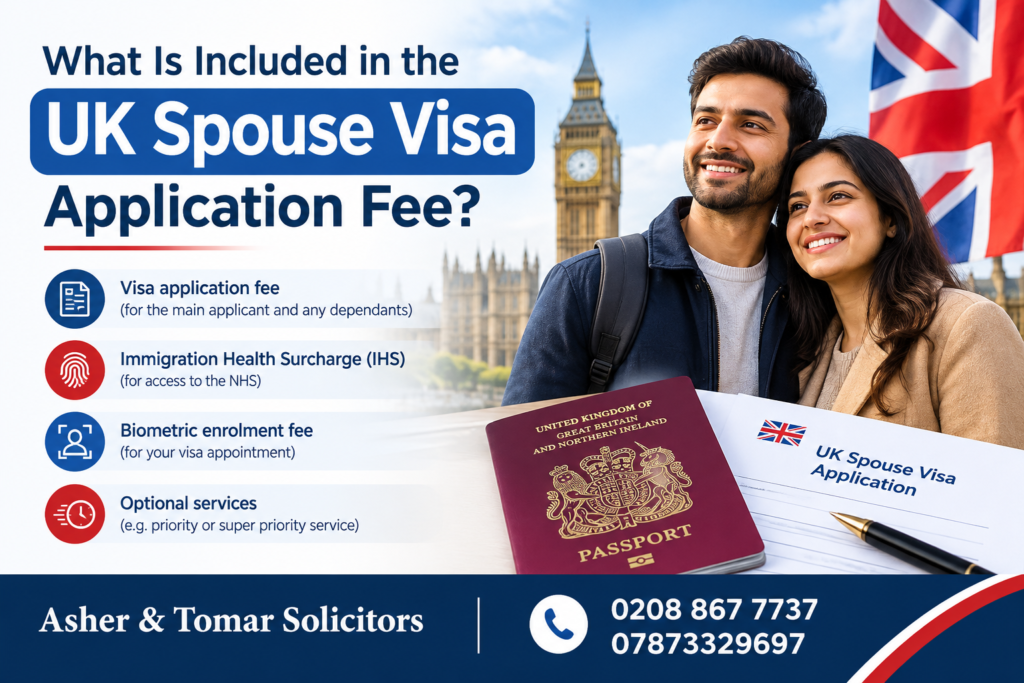
What Is Included in the UK Spouse Visa Application Fee? Understanding what is included in the UK spouse visa application fee is an important step for couples planning to live together in the United Kingdom. Although the application fee is a major part of the process, it does not necessarily cover every expense associated with obtaining a spouse visa. Applicants may also need to budget for the Immigration Health Surcharge, document preparation, English language testing, translations and optional faster processing services, depending on their circumstances. The UK spouse visa, generally covered by the family visa route for partners, allows eligible applicants to join their British or settled partner and build their lives together in the UK. To make an informed financial decision, applicants should understand the difference between mandatory government charges, optional services and professional legal fees. At Asher & Tomar Solicitors, applicants can seek guidance on the spouse visa process, the relevant eligibility requirements and the costs that may apply to their individual circumstances. What Is Included in the UK Spouse Visa Application Fee and Government Charges? The standard spouse visa application fee is the payment made to UK Visas and Immigration (UKVI) when submitting an application under the relevant family visa route. This is an official government charge for processing the application. The amount payable depends on whether the applicant is applying from outside the UK or applying to extend or switch their permission from inside the country. Fees can change, so applicants should confirm the applicable amount through the official GOV.UK family visa guidance before submitting their application. The application fee relates to the immigration application itself. It should not be confused with the Immigration Health Surcharge or fees for services provided by solicitors, translators or other third parties. Paying the application fee does not guarantee approval. UKVI considers whether the applicant satisfies the relevant immigration requirements and has supplied sufficient supporting evidence. What Is Included in the UK Spouse Visa Application Fee for Online Processing? The application process normally includes completing the relevant online form, providing personal and relationship information, declaring the required details and submitting the application with the applicable payment. Applicants may be asked to provide information about their identity, nationality, partner, previous relationships, financial circumstances and plans to live together in the UK. The precise information required depends on the applicant’s situation. The government application fee is associated with processing the application, but applicants should not assume that it includes professional assistance with completing the form, reviewing evidence or preparing legal representations. If you are unsure which family visa route applies to you, obtaining appropriate advice before submitting the application can help you understand the process and avoid preventable mistakes. What Is Included in the UK Spouse Visa Application Fee and the Immigration Health Surcharge? One of the most important points to understand is that the visa application fee and the Immigration Health Surcharge (IHS) are separate charges. The Immigration Health Surcharge is generally payable when applying for a visa lasting more than six months from outside the UK or when making an eligible immigration application from inside the UK. Certain categories and circumstances are exempt. The surcharge is paid to support access to NHS healthcare during the relevant period of permission, subject to the applicable healthcare rules. It is generally calculated according to the length of permission requested or granted under the relevant route and must usually be paid upfront. For eligible partner applications, the amount can represent a substantial part of the overall budget. The surcharge may also apply separately to eligible dependants. Applicants should calculate the visa application fee and IHS separately rather than treating them as one combined charge. The official government guidance explains who must pay and how the surcharge is calculated. What Is Included in the UK Spouse Visa Application Fee for Biometrics and Identity Checks? Applicants must also complete the required identity verification process. Depending on the application route and individual circumstances, this may involve attending an appointment at a visa application centre or using an available digital identity verification service. Where an appointment is required, applicants may need to provide fingerprints and a photograph, unless the applicable process or an exemption means these are not required. The basic identity verification procedure should be distinguished from optional services offered by external visa application centres. Services such as document scanning, assisted application support, courier delivery or premium appointment arrangements may carry additional charges. Before booking an appointment, check which services are required and which are optional. Applicants should not assume that every service advertised by an application centre is compulsory for a successful spouse visa application. What Is Included in the UK Spouse Visa Application Fee for Supporting Documents? The government application fee does not generally pay for obtaining the documents needed to demonstrate eligibility. Applicants are responsible for collecting and preparing appropriate supporting evidence. Depending on the circumstances, documents may include: Some documents may be available without charge, while others may involve administrative fees. If documents are not in English or Welsh, suitable translations may be necessary. Translation and certification costs are separate from the government visa application fee. Preparing the correct documents before submission can help applicants present a clear and organised application. Contact Asher & Tomar Solicitors for UK Spouse Visa Advice Understanding what is included in the UK spouse visa application fee can help you prepare a realistic budget and avoid overlooking additional expenses. Every application is different, and the appropriate fees and supporting documents depend on your immigration route and personal circumstances. Asher & Tomar Solicitors can assist with queries about UK spouse visa applications, eligibility requirements, supporting evidence and the application process. Contact Details Asher & Tomar Solicitors Telephone: 0208 867 7737 / 07873329697 Email: asherandtomar@aol.co.uk Website: https://asherandtomar.co.uk/ Contact the firm to discuss your circumstances and obtain information about the legal assistance available for your UK spouse visa application. What Is Included in the UK Spouse Visa Application Fee: Frequently Asked Questions What is included in the UK spouse visa
Spouse Visa Refusal Solicitor UK

Receiving a refusal on a UK Spouse Visa application can be upsetting, particularly when you have spent considerable time preparing documents and are expecting to begin or continue your family life in the UK. A refusal does not always mean that there is no further legal option. The correct next step depends on the reasons given by the Home Office, the type of application submitted and whether you have a right of appeal, administrative review or another available remedy. Speaking with a spouse visa refusal solicitor UK can help you understand the refusal decision and determine the most appropriate way forward. Why Are UK Spouse Visa Applications Refused? UK spouse visa applications can be refused for a range of reasons. The Home Office assesses whether an applicant meets the applicable Immigration Rules and whether the evidence submitted supports the information provided in the application. A refusal may relate to financial evidence, relationship requirements, English-language requirements, accommodation, supporting documents or inconsistencies in the information supplied. In some cases, an applicant may have met the requirements but failed to provide sufficient evidence to demonstrate this. Previous immigration history can also become relevant where an applicant has overstayed, breached immigration conditions, provided information that the Home Office considers misleading, or has had previous applications refused. The refusal letter is therefore extremely important. Rather than immediately submitting another application, applicants should first understand precisely why the original application was unsuccessful. What Should You Do After a Spouse Visa Refusal? The first step is to carefully read the refusal decision. It should explain the reasons why the application was refused and, where applicable, whether you have a right to appeal or request an administrative review. Do not ignore deadlines stated in the decision. Depending on the type of decision and where you are located, the applicable deadline can be short. If you are unsure about the legal consequences of the refusal, obtaining advice from a qualified immigration professional can help you assess your options before taking further action. A spouse visa refusal solicitor UK can examine the refusal letter, application form and supporting evidence to determine whether the Home Office may have made an error or whether the application had an evidential or eligibility problem. Can You Appeal a Refused Spouse Visa? Whether you can appeal depends on the legal basis of the decision. Not every visa refusal automatically carries a right of appeal. GOV.UK states that you can appeal an immigration decision to the tribunal only where you have a legal right to appeal, and the decision letter will normally explain whether such a right exists. Where an appeal is available, the deadline depends on whether the applicant is in the UK or outside the UK. GOV.UK currently states that the usual deadline is 14 days for applicants in the UK and 28 days for applicants outside the UK, calculated from receipt of the decision. Because missing a deadline can create additional complications, it is sensible to seek legal advice as soon as possible after receiving a refusal. What Is Administrative Review? Administrative review is different from an appeal. It is available only for certain eligible immigration decisions, and the refusal decision should tell you if you can apply. For eligible applications made in the UK, GOV.UK currently states that an administrative review must generally be requested within 14 days of receiving the decision. For eligible applications made outside the UK, the usual deadline is 28 days. The purpose of administrative review is to consider whether an eligible decision contains a caseworking error. The current Home Office guidance explains that administrative review can address permitted caseworking errors where the relevant requirements are satisfied. It is therefore important not to assume that an administrative review and an appeal are interchangeable. The appropriate route depends on the refusal and the rights stated in your decision letter. How Can a Spouse Visa Refusal Solicitor Help? A solicitor can begin by examining the refusal decision and identifying the specific reasons given by the Home Office. This may involve reviewing the original application, financial documents, relationship evidence, correspondence, immigration history and other relevant information. The purpose is to establish whether the refusal resulted from an error, insufficient evidence, failure to meet a requirement or another issue. Legal assistance may then involve preparing an appeal, advising on an administrative review where available, or considering whether a fresh application could be more appropriate. The correct strategy will always depend on the individual case. What Are Common Financial Reasons for Refusal? Financial evidence is one of the areas that can require careful preparation in a spouse visa application. Problems may arise where documents do not meet the relevant evidential requirements, income has been calculated incorrectly, documents are incomplete or information in the application does not match the supporting evidence. Applicants relying on employment income, self-employment, savings or other permitted sources need to provide evidence appropriate to their circumstances. If a refusal refers to the financial requirement, it is important to understand exactly what the Home Office considered insufficient. Simply submitting the same documents again may not resolve the underlying issue. Can Relationship Evidence Lead to Refusal? Yes. The Home Office may consider whether the applicant has demonstrated a qualifying relationship and whether the evidence supports the information provided. Relationship evidence can include records of communication, visits, photographs, travel arrangements, shared financial responsibilities and evidence of living together where applicable. However, submitting a large number of documents does not necessarily make an application stronger. The evidence should be relevant, genuine and organised in a way that clearly explains the relationship. If the Home Office has raised concerns about the relationship, a spouse visa refusal solicitor UK can review the evidence and advise on the specific issue identified in the refusal. What If Your Spouse Visa Was Refused Because of Missing Documents? Missing or inadequate documents can sometimes contribute to a refusal. The significance of missing evidence depends on the document, the relevant Immigration Rules and the circumstances of the application. It is
Spouse Visa Application Lawyer UK

Applying for a UK Spouse Visa can be an important step towards building a life together in the United Kingdom, but the application requires careful preparation and accurate supporting evidence. Applicants generally need to demonstrate that their relationship meets the relevant requirements, satisfy the financial and English-language rules, and provide appropriate documentation. Working with a spouse visa application lawyer UK can make the process more organised by helping you understand the requirements, identify potential weaknesses and prepare the application before submission. Asher & Tomar Solicitors provide immigration legal support for clients dealing with UK spouse visa applications and related family immigration matters. What Is a UK Spouse Visa? A UK Spouse Visa is a family visa route for eligible partners who want to live with their spouse or partner in the UK. The applicant must satisfy the applicable relationship, financial, English-language and other immigration requirements. The route can be relevant where one partner is a British citizen or has qualifying immigration status in the UK. The exact requirements depend on the applicant’s circumstances, including whether the application is being made from outside or inside the UK. Because immigration rules can be detailed, applicants should not rely solely on general examples found online. A document that appears suitable for one applicant may not necessarily be appropriate for another. Why Should You Use a Spouse Visa Application Lawyer UK? A spouse visa application involves more than completing an online form. The supporting evidence needs to correspond with the information provided and should clearly demonstrate how the applicant meets the relevant Immigration Rules. A spouse visa application lawyer UK can review your circumstances before the application is submitted and help you understand which evidence may be relevant. Professional assistance can also be particularly useful where there are previous visa refusals, complicated financial circumstances, previous relationships, immigration history or questions about relationship evidence. Legal guidance does not guarantee a successful outcome, but careful preparation can help reduce avoidable mistakes and improve the clarity and consistency of an application. Who Can Apply for a UK Spouse Visa? The eligibility requirements depend on the applicant’s circumstances. In general, applicants applying as a partner or spouse need to demonstrate a qualifying relationship and meet other applicable requirements. The relationship may be based on a marriage or civil partnership recognised in the UK, while specific provisions can also apply to unmarried partners and other family circumstances. Applicants must also satisfy the relevant immigration requirements concerning English language ability and finances unless an exemption or alternative route applies. The Home Office may also examine evidence showing that the relationship is genuine and that the couple intend to live together permanently in the UK. What Financial Requirement Applies to a UK Spouse Visa? For many new partner or spouse applications, the current minimum income requirement is £29,000 per year. There are different rules and possible exceptions depending on when a person first applied and the circumstances of the case. Applicants may need to provide evidence such as payslips, bank statements and an employer’s letter where employment income is being relied upon. Other permitted sources of income and savings can apply depending on the circumstances. This is an area where mistakes can have serious consequences. For example, submitting incomplete financial evidence or using an incorrect category of income may create difficulties with an application. A lawyer can review the financial circumstances and help determine what evidence may be required before submission. How Important Is Relationship Evidence? Relationship evidence is an important part of a spouse visa application. The Home Office may require information about how the relationship developed, how often the couple communicate, whether they have lived together and how they share aspects of their lives. Where a couple lives apart, evidence may include communication records, travel history, photographs, financial support and evidence of time spent together. Where the couple lives together, documents such as council tax records or other correspondence may help demonstrate shared residence. The evidence should be genuine and relevant rather than simply being a large collection of documents. A well-organised application can make it easier for the decision-maker to understand the relationship. What Documents Are Needed for a UK Spouse Visa? The precise document list varies according to the applicant’s circumstances. Documents may include passports, marriage or civil partnership evidence, financial documents, relationship evidence, accommodation information and evidence relating to English-language requirements. Financial evidence can be particularly detailed. Depending on the income source, applicants may need payslips, bank statements, employment letters, tax documents or other supporting records. GOV.UK confirms that the evidence required depends on how income is obtained. A spouse visa application lawyer UK can help you create a case-specific document checklist rather than relying on a generic list that may not apply to your situation. How Can a Lawyer Help With the Application Form? The online application form contains numerous questions about the applicant, sponsor, relationship, previous immigration history and supporting circumstances. Information entered into the form should be accurate and consistent with the documents submitted. A lawyer can help identify information that requires clarification and can review the application before submission. This can be useful where the applicant has a complicated immigration history or where the financial and relationship evidence requires careful explanation. Professional review can also help ensure that important information is not overlooked. What If Your Spouse Visa Application Is Refused? A refusal can be extremely stressful, particularly when a couple has spent significant time and money preparing the application. The appropriate response depends on the reason for refusal and the legal options available. In some circumstances, it may be appropriate to challenge a decision, while in others a new application may be considered. The refusal letter should be reviewed carefully because it explains the decision and the issues identified by the Home Office. Asher & Tomar also provides immigration appeal services, including assistance relating to certain spouse visa and family immigration refusals. Getting legal advice promptly after a refusal can help you understand the available options rather than submitting another
UK Spouse Visa Total Cost Fees Extra Expenses 2026: What Should You Budget For?

Planning to move to the UK to live with your husband, wife or eligible partner involves more than completing an online visa form. One of the most important practical questions is the UK Spouse Visa Total Cost Fees Extra Expenses 2026 and how much money you should realistically set aside before beginning the application. The government application fee is only one part of the overall expense. Depending on your circumstances, you may also need to pay the Immigration Health Surcharge, English language test fees, tuberculosis testing charges, document translation costs, travel expenses and optional priority service fees. For applicants applying from outside the UK, the current Family Visa application fee for joining a partner is £2,064. An adult may also need to pay £2,587.50 for the Immigration Health Surcharge when the relevant permission covers 2 years and 6 months. UK Spouse Visa Total Cost Fees Extra Expenses 2026: Start With the Main Government Charges The first expenses to consider are the mandatory government charges. For a partner or spouse applying from outside the UK, the current application fee is £2,064. Each eligible dependant applying under the relevant family route may also have a separate application fee. The Immigration Health Surcharge is generally an additional payment rather than something included in the visa application fee. For an adult, GOV.UK currently lists: The amount depends on the period of immigration permission and the circumstances of the application. Therefore, for a typical adult applying from outside the UK with a 2-year-6-month period, the two major government charges alone can total £4,651.50. That is before considering the other costs associated with preparing the application. UK Spouse Visa Total Cost Fees Extra Expenses 2026: Why the IHS Matters The Immigration Health Surcharge can represent a significant proportion of the overall cost. The current standard IHS rate for most visa and immigration applications is £1,035 per year. The amount is calculated according to the length of permission rather than simply being a flat fee for every applicant. Applicants should also understand that having private medical insurance does not automatically remove the IHS requirement where the surcharge applies. GOV.UK explains that people who qualify for an exemption may not have to pay it. This is why calculating the visa budget using only the £2,064 application fee can give an unrealistic picture of the actual expense. What Additional Costs Can Increase Your UK Spouse Visa Budget? Every applicant’s circumstances are different. Some people may have relatively few additional expenses, while others may need to spend considerably more preparing their evidence. English Language Test Costs If you need to demonstrate your English language ability through an approved test, the test itself will have a separate cost. The price can vary depending on the country, provider and test centre. Before booking, make sure the test is accepted for the immigration route and that you are taking the appropriate level. Booking the wrong examination can result in unnecessary expense and delays. TB Test Expenses Applicants from certain countries may need a tuberculosis test before applying for a UK visa. The test must normally be completed through an approved clinic where the requirement applies. The cost varies from country to country, so applicants should check the current approved clinic information rather than relying on an old fee quoted online. Certified Translation Costs Not every applicant will need translations, but this can become an important expense where supporting documents are not in English or Welsh. Marriage certificates, financial documents, identity documents and other evidence may need suitable translations depending on the circumstances. The final cost depends on: Preparing your documents early can help you understand this expense before submitting your application. Does a UK Spouse Visa Require a Biometric Fee? Applicants need to prove their identity as part of the application process. Depending on the circumstances, this may involve using the UK Immigration: ID Check app or attending a visa application centre to provide fingerprints and a photograph. Whether you incur additional service-centre charges can depend on where you apply and what services are available. You may also need to consider the cost of travelling to the appointment. For applicants living far from the nearest visa application centre, transport and accommodation can become a meaningful part of the overall budget. How Much Should You Budget for Travel to a Visa Application Centre? This expense is easy to overlook. If your nearest visa application centre is in another city, you may need to pay for: GOV.UK notes that applicants who need an appointment may sometimes have to travel to another country to reach a visa application centre. Therefore, the true cost of a Spouse Visa is not necessarily the amount shown on the government payment screen. Can Priority Processing Increase the UK Spouse Visa Cost? Some applicants may have access to faster decision-making services. These services are optional and availability depends on the application route and location. The additional payment is separate from the standard visa application fee. It is important to check whether the service is actually available to you before including it in your financial planning. Paying for faster processing also does not change the eligibility requirements or guarantee that an application will be approved. What About Immigration Solicitor Fees? Professional immigration advice is another cost that some applicants choose to include in their budget. There is no single fixed solicitor fee because applications differ considerably. A straightforward application with clear employment income may require less assistance than a case involving: If you are uncertain about your eligibility or evidence, professional guidance before submission can help you understand potential weaknesses rather than discovering them after a refusal. For assistance with your UK Spouse Visa application, contact Asher & Tomar on 0208 867 7737, 07873329697 or 07454 229810, or email asherandtomar@aol.co.uk. How Does the Financial Requirement Affect Your Visa Planning? Visa fees and the financial requirement are two completely different things. Paying the application fee does not mean that you have satisfied the financial requirement. For most new partner applications under the
How to Apply for a UK Spouse Visa from Outside the UK
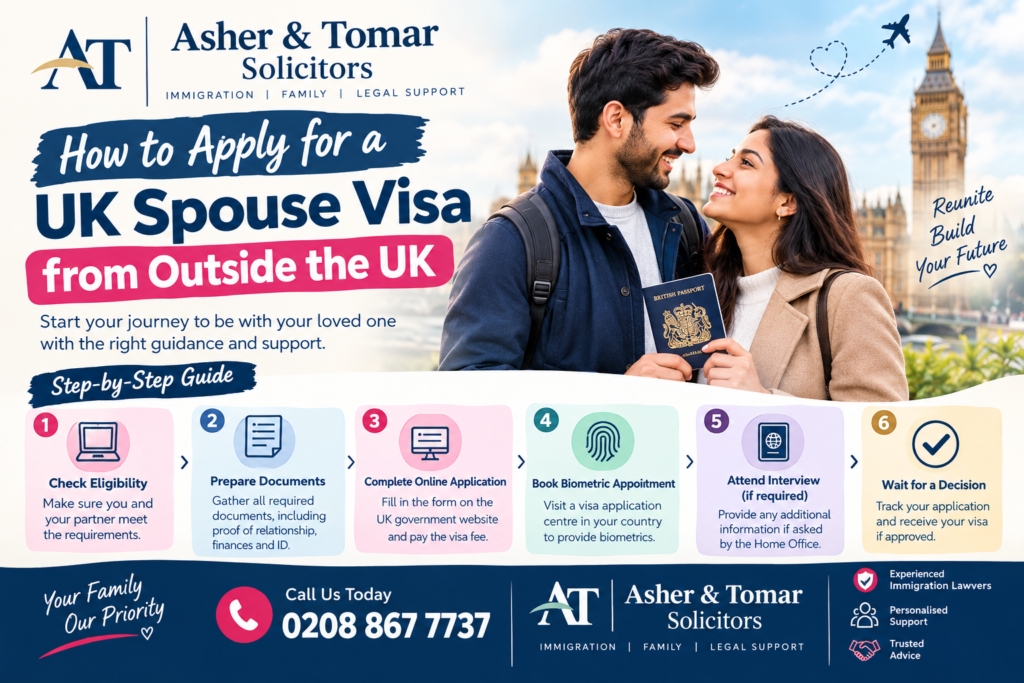
If your husband, wife or eligible partner is living in the UK and you want to join them permanently, understanding how to apply for a UK Spouse Visa from outside the UK is an important first step. The UK Spouse Visa is part of the Family Visa route and allows an eligible partner to live with their spouse or partner in the UK. When applying from overseas, the application must be submitted online and you will need to provide evidence covering your relationship, finances, English language ability and other eligibility requirements. The application can involve a significant amount of documentation, particularly where income comes from self-employment, savings, multiple jobs or other sources. Preparing the evidence carefully before submitting the application can help reduce avoidable problems. How to Apply for a UK Spouse Visa from Outside the UK in 2026 The UK Spouse Visa application process starts with checking whether you and your UK-based partner satisfy the relevant eligibility requirements. You normally need to demonstrate that your relationship is genuine and that you intend to live together permanently in the UK. You must generally be married, in a civil partnership or meet the requirements for an eligible unmarried partner relationship. Your UK partner must also have the appropriate status in the UK, such as British or Irish citizenship, settled status or another qualifying immigration status. If you are applying from outside the UK, the application is made online before travelling to the UK. How to Apply for a UK Spouse Visa from Outside the UK: Check Your Eligibility Before completing the application form, carefully check the eligibility criteria. The main areas usually include: Meeting one requirement does not automatically guarantee approval. The Home Office assesses the overall application and the evidence submitted. How to Apply for a UK Spouse Visa from Outside the UK: Financial Requirement One of the most important parts of a Spouse Visa application is proving that the financial requirement is satisfied. For applications under the current rules, the standard minimum income requirement is generally £29,000 per year for the applicant and their partner combined. The exact evidence required depends on the type and source of income being relied upon. Employment income, self-employment income, pensions, certain non-employment income and qualifying cash savings may be relevant depending on the circumstances. For example, an employed sponsor may need documents such as payslips, bank statements and an employer’s letter. Self-employed applicants may have additional financial evidence requirements. It is important not to assume that having £29,000 in a bank account automatically satisfies the requirement. The Home Office has specific rules about how different sources of income and savings must be evidenced. If you are unsure whether your financial circumstances meet the rules, professional immigration advice can help you identify the correct evidence before submitting your application. What Documents Are Required for a UK Spouse Visa from Outside the UK? Preparing the correct documents is one of the most important stages of the application. Depending on your circumstances, you may need to provide: GOV.UK confirms that applicants may need to provide personal information, passport details, previous immigration information, financial evidence, relationship evidence and, where applicable, tuberculosis test results and certified translations. The precise document list can vary depending on your circumstances, so copying another applicant’s checklist is not always appropriate. How to Prove a Genuine Relationship for a UK Spouse Visa A successful Spouse Visa application needs to demonstrate that the relationship is genuine and continuing. Evidence can include documents showing how you met, communication between you, visits to see each other, photographs, joint financial responsibilities and other relevant evidence. You do not necessarily need to submit hundreds of pages of messages or photographs. What matters is presenting relevant evidence in an organised way that clearly explains your relationship. The Home Office may ask questions about your relationship, including how you met, how often you communicate and whether you have lived together. A well-organised relationship evidence bundle can make it easier for the caseworker to understand the history and circumstances of your relationship. What Is the English Language Requirement for a UK Spouse Visa? Applicants generally need to demonstrate their knowledge of English unless an exemption applies. Depending on your circumstances, this may involve passing an approved English language test or relying on another permitted form of evidence, such as an eligible degree taught in English. The exact level and evidence required can depend on whether this is your first application, an extension or another stage of your immigration journey. It is therefore important to check the requirement that applies specifically to your application rather than relying on general information found online. How to Apply for a UK Spouse Visa from Outside the UK: Submit the Application Once your eligibility and documents have been checked, you can complete the online application. The application asks for detailed information about you, your partner, your relationship, finances, immigration history and other relevant circumstances. Before submitting the form, carefully check: A small inconsistency does not always result in refusal, but unexplained discrepancies can create unnecessary questions. What Happens After Applying for a UK Spouse Visa from Outside the UK? After submitting the application, you will normally need to attend an appointment to provide your biometric information, including fingerprints and a photograph. GOV.UK states that applicants are told how to arrange the appointment as part of the application process. You may need to attend a visa application centre, and depending on where you live, this could involve travelling to another location or country. Your documents will be submitted according to the instructions provided during the application process. Once the application has been submitted, UK Visas and Immigration will assess the information and evidence before making a decision. How Long Does a UK Spouse Visa Take from Outside the UK? Current GOV.UK service information indicates that applicants applying as a partner or spouse from outside the UK who meet the relevant requirements normally have a service standard of around 12 weeks. However, processing times can vary. Additional
ILR After Spouse Visa: Requirements, Eligibility & Application Guide
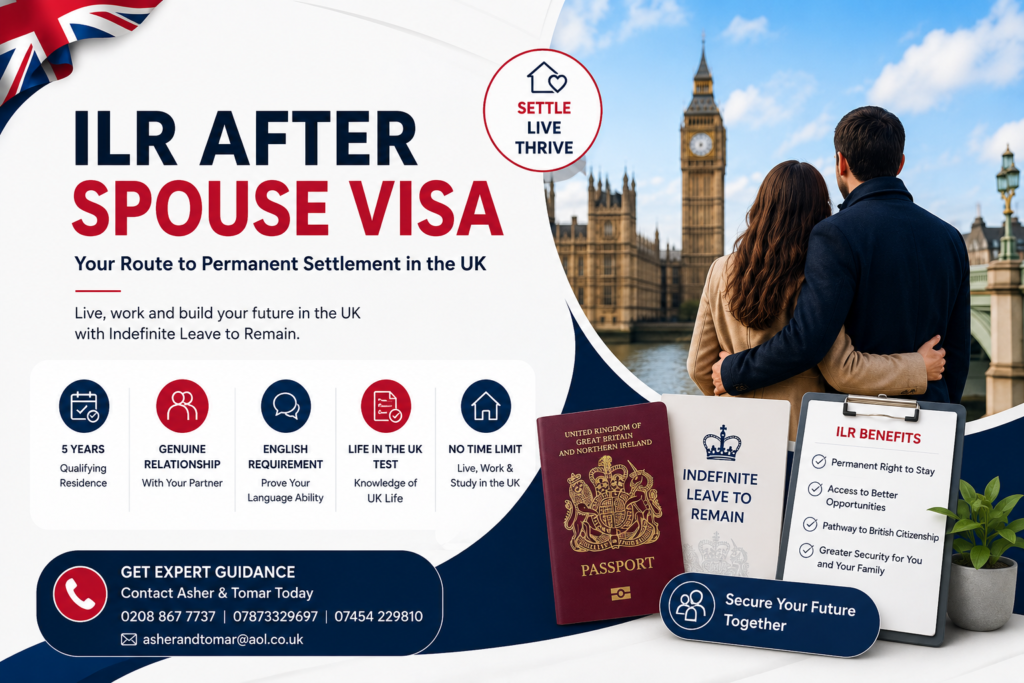
ILR after Spouse Visa is an important milestone for people who have lived in the UK with their British or settled partner and are looking to secure permanent immigration status. Indefinite Leave to Remain (ILR) allows eligible applicants to live and work in the UK without a time limit and can be an important step towards British citizenship. For many people on the five-year family route, ILR after Spouse Visa may become available after completing the required qualifying period, provided they meet the relevant immigration, financial, relationship, residence and English-language requirements. The rules surrounding settlement can be detailed, particularly where an applicant has changed immigration categories, spent significant time outside the UK or has had previous visa issues. Understanding the requirements before applying can help you prepare the correct evidence. What Is ILR After Spouse Visa? ILR after Spouse Visa refers to applying for Indefinite Leave to Remain after completing the required period on the UK family visa route as a partner. Unlike a temporary Spouse Visa, ILR generally provides permission to remain in the UK without a time limit. It can also remove some of the restrictions associated with temporary immigration permission. However, receiving a Spouse Visa does not automatically lead to ILR. You must satisfy the settlement requirements that apply to your circumstances when you make your application. How Long Does It Take to Get ILR After Spouse Visa? For applicants following the standard five-year partner route, ILR after Spouse Visa is generally considered after five continuous years of qualifying residence as a partner. The qualifying period must be assessed carefully. Time spent in other immigration categories may not necessarily count towards the five-year partner route. Applicants should also consider the continuous residence requirements, permitted absences and the immigration status they held during the qualifying period. What Are the ILR After Spouse Visa Requirements? The ILR after Spouse Visa requirements can include several areas of eligibility. Applicants normally need to demonstrate that they continue to meet the requirements of the partner route and satisfy the settlement rules. Key areas can include: The exact requirements can depend on the date and route under which you first entered the family visa category. Does the Relationship Need to Continue for ILR? Yes, relationship requirements are an important part of ILR after Spouse Visa applications made under the partner route. You will generally need to demonstrate that your relationship with your spouse or partner continues to meet the requirements of the relevant immigration route. Evidence can include documents demonstrating your shared life and circumstances. The appropriate evidence will depend on your situation. If your relationship has broken down, you should obtain specific immigration advice before making an ILR application because different immigration considerations may apply. Is There an English Requirement for ILR After Spouse Visa? The English requirement for ILR after Spouse Visa is different from simply meeting the English requirement for your original Spouse Visa. Applicants seeking settlement may need to demonstrate the required level of English unless they qualify for an exemption or meet the requirement in another permitted way. The evidence accepted can depend on your circumstances, including your nationality, qualifications and previous immigration applications. Before applying, check that your English evidence satisfies the settlement rules applicable to you. Do You Need to Pass the Life in the UK Test? The Life in the UK Test for ILR after Spouse Visa is an important requirement for many settlement applicants. The test assesses knowledge of British traditions, history, government and everyday life. Applicants who are required to take the test should make sure they pass it before submitting their settlement application. Certain applicants may qualify for an exemption, so it is important to establish whether the requirement applies to you. Does the Financial Requirement Apply to ILR After Spouse Visa? The ILR after Spouse Visa financial requirement needs careful consideration because settlement requirements are not necessarily identical to the requirements for extending a temporary Spouse Visa. Applicants should review the financial requirements applicable to their settlement route and provide the correct supporting evidence. Depending on your circumstances, documents may include evidence relating to employment, income, self-employment or other relevant financial information. Do not assume that the documents used for your previous Spouse Visa application will automatically be sufficient for ILR. What Documents Are Needed for ILR After Spouse Visa? The documents for ILR after Spouse Visa will depend on your individual circumstances, but applicants should expect to provide evidence supporting their identity, residence, relationship and eligibility. Potential documents can include: The Home Office can request additional information if necessary. What Is Continuous Residence for ILR After Spouse Visa? Continuous residence for ILR after Spouse Visa means meeting the residence requirements during the relevant qualifying period. Applicants should carefully review their travel history and calculate time spent outside the UK. Even where travel was for holidays, family reasons or work, the dates should be recorded accurately. Keeping a clear record of international travel throughout your Spouse Visa period can make the ILR preparation process much easier. If you have spent extended periods outside the UK, professional advice may be useful before submitting an application. Can You Apply for ILR Before Your Spouse Visa Expires? You can generally apply for settlement once you become eligible under the applicable rules. However, timing is important. Applying too early can create eligibility problems, while leaving your application until the last moment can create unnecessary pressure. Before submitting an ILR after Spouse Visa application, check your qualifying date, immigration history and current visa expiry date carefully. What Happens After You Get ILR? Once your ILR after Spouse Visa application is approved, you will generally have settlement in the UK rather than temporary permission. ILR can provide greater long-term security and may also be relevant to a future application for British citizenship, provided you meet the separate nationality requirements. It is important to remember that ILR and British citizenship are not the same thing. Citizenship involves its own eligibility criteria and application process. Why Get Professional